
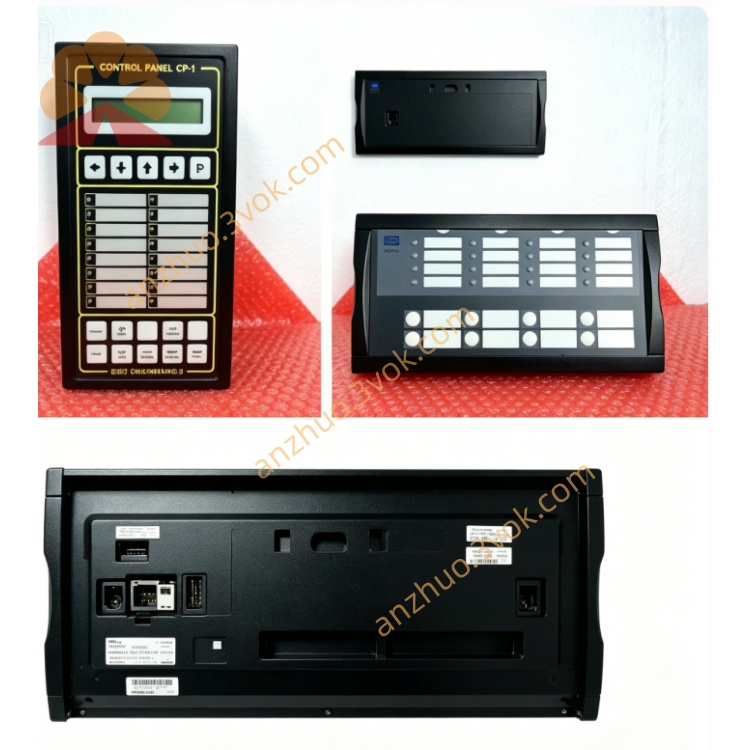
Description
1. Product Overview
2. Key Features
3-Phase Precision Measurement: Class 0.5 accuracy for voltage (0–690 VAC direct) and current (via CTs)DEIF.
Integrated Synchronisation: Automatic synchronisation (frequency, phase, voltage matching) for generator-grid and generator-generator paralleling.
Configurable Protection: Vector jump (Δφ), over/underfrequency, over/undervoltage, and reverse power protectionDEIF.
Dual Voltage Inputs: 2× direct 3-phase voltage (L1/L2/L3/N) inputs (40–70 Hz, max 690 VAC)DEIF.
Galvanic Isolation: 2.2 kV isolation (relay outputs ↔ all other potentials); 550 V isolation (digital inputs ↔ others)DEIF.
Communication Interfaces: CAN (125–1000 kBd), RS485 (Modbus RTU), and backplane bus for DM-4 rack integrationDEIF.
Hardware Configuration: Rotary switch (I/O address, 0–3); jumpers for function selection (X10/X13/X20).
Certifications: CE, IEC 61010-1 (Overvoltage Cat III, 690 VAC), IEC 60688 (accuracy), marine compliance (DNV/GL, ABS)DEIF.
Rack Mount: 6TE (30.48 mm) width, fits 42TE/60TE DM-4 racksDEIF.
3. Technical Specifications
3.1 Electrical Ratings
| Parameter | Specification |
|---|---|
| Model | SCM4-1 (SCM4.1) |
| Manufacturer | DEIF A/S |
| Part Number | 4921240468 (standard) |
| Power Supply | |
| – Auxiliary Voltage | 24 VDC ±20% (18–30 VDC), ≤15 WDEIF |
| – Backplane Supply | 5 VDC (from DM-4 rack) |
| Measurement Inputs | |
| – Voltage Inputs | 2× 3-phase (L1/L2/L3/N), 40–70 Hz, 0–690 VAC (direct)DEIF |
| – Current Inputs | 3× CT inputs (5 A / 1 A secondary), Class 0.5DEIF |
| – Accuracy | ±0.5% (ref temp); ±1.0% (operational temp)DEIF |
| Protection & Control | |
| – Synchronisation Range | Δf: ±0.5 Hz; Δφ: ±10°; ΔU: ±10% Un |
| – Vector Jump Detection | Adjustable Δφ threshold (5°–30°)DEIF |
| – Frequency Protection | 40–70 Hz (adjustable U/F: 90–100% fn; O/F: 100–110% fn) |
| – Voltage Protection | 80–120% Un (adjustable U<: 80–100% Un; U>: 100–120% Un) |
| Digital I/O | |
| – Inputs | 8× isolated digital inputs (24 VDC, 550 V isolation)DEIF |
| – Outputs | 4× relay outputs (NO/COM/NC, 250 VAC / 8 A resistive, 2.2 kV isolation)DEIF |
| Communication | |
| – CAN | 2× CAN 2.0A/B (125/250/500/1000 kBd)DEIF |
| – RS485 | 1× Modbus RTU (9600–38400 Bd)DEIF |
| – Backplane Bus | DM-4 internal bus (I/O address: 0–3 via rotary switch) |
3.2 Environmental & Mechanical
| Parameter | Specification |
|---|---|
| Operating Temperature | –20 °C to +70 °C (marine: –30 °C to +60 °C)DEIF |
| Storage Temperature | –40 °C to +85 °C |
| Humidity | 5–95% RH non-condensing |
| Vibration | 2–13.2 Hz: ±0.7 mm; 13.2–100 Hz: ±0.5 g |
| Enclosure | IP20 (front/terminals); conformal coated PCBDEIF |
| Dimensions (W×H×D) | 30.48 × 160 × 120 mm (6TE, double euro format)DEIF |
| Weight | Approx. 0.8 kg |
| Mounting | DM-4 42TE/60TE rack (horizontal)DEIF |
4. Application Scope
Generator Synchronisation: Automatic paralleling of diesel/gas/steam generators to grid or bus tie (marine/industrial).
Power Management: Load sharing, frequency/voltage control, and reverse power protection for islanded systems.
Grid Monitoring: 3-phase grid voltage/current measurement and protection (vector jump, frequency/voltage anomalies)DEIF.
Marine Switchboards: Shipboard power distribution (IEC 60945 certified) and generator control panelsDEIF.
Industrial Plants: Combined heat and power (CHP) systems, backup generator paralleling, and mains failure (AMF) control.
DM-4 System Integration: Core I/O module for Delomatic 4 (DM-4) hydro/gas/land controller racksDEIF.
5. Installation & Wiring
5.1 Installation Requirements
Rack Mounting: Insert SCM4-1 into a 6TE slot in a DM-4 42TE/60TE rack (horizontal only); secure with front panel screws.
Slot Clearance: Maintain ≥25 mm vertical clearance for ventilation; avoid blocking rack fans.
ESD Protection: Use anti-static wristband and grounded ESD mat when handling (static-sensitive PCB).
Cable Separation: Separate high-voltage (690 VAC) measurement cables from low-voltage (24 VDC) control/communication cables by ≥10 cm.
5.2 Hardware Configuration (Before Power-On)
I/O Address Setting: Rotate the front-panel rotary switch to set a unique address (0–3); all SCM4.1/SCM4.2 modules must have distinct addresses.
Jumper Settings (X10/X13/X20): Set all jumpers to OFF (default for standard synchronisation/measurement mode).
CT Ratio Configuration: Set internal jumpers to match current transformer secondary (5 A or 1 A).
5.3 Terminal Wiring (Simplified)
| Terminal | Description | Wire Gauge |
|---|---|---|
| 3-Phase Voltage Input 1 (Generator) | ||
| L1/L2/L3/N | Generator Voltage (0–690 VAC) | 2.5 mm² |
| 3-Phase Voltage Input 2 (Grid) | ||
| L1/L2/L3/N | Grid Voltage (0–690 VAC) | 2.5 mm² |
| Current Transformer Inputs | ||
| CT1/CT2/CT3 | Generator CT Secondary (5 A/1 A) | 1.5 mm² |
| Auxiliary Supply | ||
| +24V/GND | 24 VDC ±20% | 1.5 mm² |
| PE | Chassis Ground | 4 mm² |
| Digital Inputs (24 VDC) | ||
| DI1–DI8 | Isolated Digital Inputs | 1.5 mm² |
| Relay Outputs | ||
| RO1–RO4 | NO/COM/NC (250 VAC/8 A) | 1.5 mm² |
| Communication | ||
| CAN_H/CAN_L | CAN Bus (125–1000 kBd) | 1.5 mm² |
| RS485_A/B | Modbus RTU | 1.5 mm² |
Voltage Inputs: Use shielded cable for 690 VAC inputs; ground shield at SCM4-1 end only.
CT Wiring: Short unused CT terminals; avoid open-circuit CTs (hazardous high voltage).
Terminal Torque: Tighten terminals to 0.8–1.0 Nm to prevent loose connections and overheating.
Fusing: Protect 24 VDC supply with 3 A slow-blow fuse; voltage/CT inputs require no external fusing.
6. Front Panel & Operation
6.1 Front Panel Layout
LED Indicators (Left to Right)
PWR: On = 24 VDC auxiliary supply OK.
RUN: Flashing = Module operational (1 Hz); Solid = Fault.
SYNC: On = Synchronisation active; Flashing = Synchronisation in progress.
ALARM: On = Fault detected (vector jump, frequency/voltage error).
CAN: Flashing = CAN bus communication active.
RS485: Flashing = Modbus RTU communication active.
Rotary Switch: I/O address (0–3) for DM-4 backplane bus.
Jumpers: X10/X13/X20 (function selection, default OFF).
6.2 Startup & Configuration
Physical Installation: Mount SCM4-1 in DM-4 rack; wire voltage/current inputs, auxiliary supply, I/O, and communication cables.
Hardware Setup: Set rotary switch to unique address (0–3); set X10/X13/X20 jumpers to OFF.
Power On: Apply 24 VDC auxiliary supply; PWR LED solid green; RUN LED flashes (1 Hz).
Software Configuration (via DM-4 Controller/PC Tool)
Set system nominal frequency (50 Hz / 60 Hz).
Set CT ratio (e.g., 2000/5 A) and VT ratio (if used).
Configure synchronisation parameters (Δf: ±0.2 Hz; Δφ: ±5°; ΔU: ±5% Un).
Enable protection functions (vector jump: 15°; U/F: 47.5 Hz; O/F: 52.5 Hz; U<: 360 V; U>: 440 V for 400 V system).
Communication Setup: Configure CAN baud rate (500 kBd) and Modbus address (1–247).
6.3 Normal Operation
PWR: Solid green; RUN: Flashing green (1 Hz).
SYNC: Off (no synchronisation) or solid green (synchronised).
ALARM: Off; CAN/RS485: Flashing green (communication active).
Relays: De-energised (NO open, NC closed).
6.4 Synchronisation Process
Detection: SCM4-1 measures generator and grid voltage/frequency/phase.
Matching: Controller adjusts generator speed (Δf → 0) and voltage (ΔU → 0); phase angle (Δφ) reduces to 0°.
Closure: When Δf < ±0.2 Hz, Δφ < ±5°, ΔU < ±5% Un for 1 second, SYNC LED solid green; closure relay energises to close generator breaker.
6.5 Fault Operation (Vector Jump)
ALARM: Solid red; RUN: Solid red.
Fault Trigger: Sudden phase shift >15° (adjustable) between generator and grid.
Action: Trip relay energises; opens generator breaker to prevent out-of-phase paralleling.
Reset: Clear fault via DM-4 controller; reset automatically when phase stabilises.
7. Safety Precautions
High Voltage Hazard: Only qualified electrical personnel may install/service. Disconnect all power sources (24 VDC + 690 VAC inputs) before wiring.
CT Hazard: Never open-circuit current transformer terminals (induces hazardous high voltage).
ESD Sensitivity: Static electricity can damage internal PCB. Use anti-static wristband and grounded ESD mat.
Relay Load Ratings: Do not exceed 250 VAC/8 A per output; inductive loads require external surge suppression.
No Unauthorised Modification: Do not open the enclosure or modify internal circuits. Tampering voids warranty and may cause unsafe operation.
Environmental Limits: Do not operate outside –20 °C to +70 °C (standard) or –30 °C to +60 °C (marine)DEIF.
8. Maintenance & Storage
8.1 Regular Maintenance (Every 12 Months)
Visual Inspection: Check for loose terminals, damaged wiring, corrosion, or overheating signs (discolouration).
Cleaning: Wipe front panel with dry lint-free cloth; no liquid cleaners (avoid water ingress).
LED Check: Verify PWR/RUN/SYNC/ALARM/CAN/RS485 LEDs operate correctly.
Terminal Tightness: Retorque all terminals to 0.8–1.0 Nm.
Functional Test: Inject 3-phase voltage/current; verify synchronisation, protection thresholds, and relay operation.
Insulation Resistance: Voltage/CT inputs to ground ≥1 MΩ @ 500 VDC.
8.2 Storage Guidelines
Packaging: Store in original anti-static packaging with desiccant.
Environment: 10–30 °C, 30–70% RH, dry, clean, and dust-free.
Protection: Avoid direct sunlight, extreme temperatures, and mechanical shock/vibration.
Duration: Shelf life ≤5 years; inspect for ESD damage and test basic functions before use if stored longer.
9. Troubleshooting
| Fault Phenomenon | Possible Cause | Solution |
|---|---|---|
| PWR LED Off | No 24 VDC supply / blown internal fuse | Check DC wiring; replace 3 A fuse. |
| RUN LED Solid Red | Module fault / invalid configuration | Reboot module; verify rotary switch/jumper settings. |
| SYNC LED Not On (Stable Params) | Δf/Δφ/ΔU thresholds too tight | Widen synchronisation tolerance (Δf: ±0.5 Hz; Δφ: ±10°). |
| ALARM LED On (Vector Jump) | Loose voltage wiring / unstable grid | Retorque voltage terminals; check grid stability. |
| CAN/RS485 LED Off | Communication wiring error / wrong baud rate | Check bus wiring; verify baud rate/address settings. |
| Relay Chatters | Loose wiring / unstable 24 VDC supply | Retorque terminals; stabilize auxiliary supply. |
10. Warranty & Disclaimer
Model: SCM4-1 (SCM4.1) Synchronisation, Control & Measuring Module.
Warranty Period: 24 months from delivery date (normal installation/use per manual).
Warranty Exclusions: Misuse, overvoltage, lightning, water ingress, unauthorised modification, improper maintenance, or CT open-circuit faults.
Specifications Subject to Change: Manufacturer reserves the right to update specifications without prior notice.
Liability Limitation: Manufacturer is not liable for indirect or consequential damages (e.g., downtime, lost revenue, equipment damage).
Documentation Version: 1.0 (2026); latest manual available at www.deif.com.
Get a Quote