
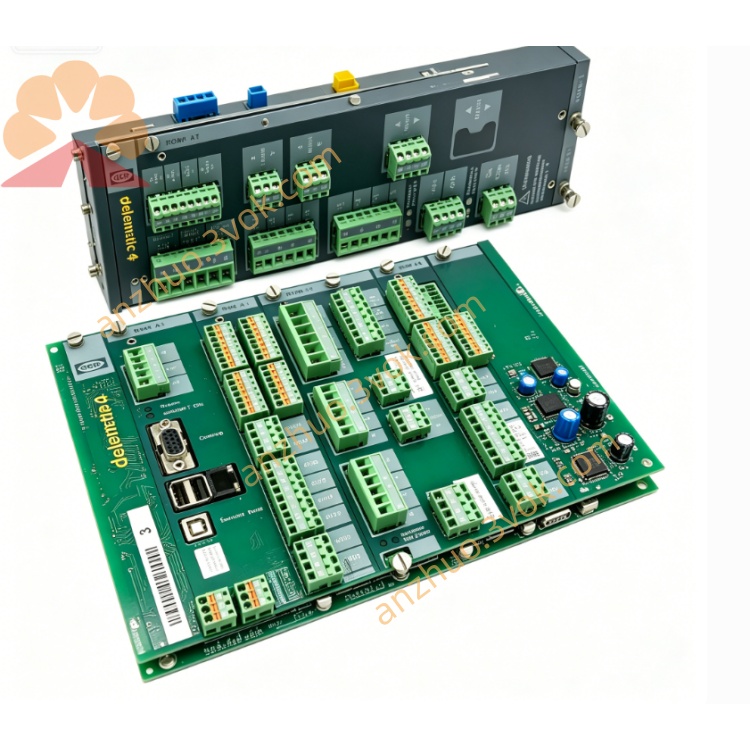
Description
1. Product Overview

2. Key Features
Dual Frequency Protection: Independent underfrequency (90–100% fn) and overfrequency (100–110% fn) stages.
Adjustable Setpoints:
Underfrequency: 90–100% of rated frequency (fn: 50/60 Hz).
Overfrequency: 100–110% of fn.
Adjustable Time Delays: 0–10 seconds for both stages (definite‑time).
Wide Voltage Input: 60–120% Un (100/110/230/400/440 VAC).
Dual Relay Outputs: 1× NO/COM/NC per stage (U/F, O/F) for trip/alarm.
LED Status Indicators: POWER, UNDERFREQ, OVERFREQ for clear diagnostics.
Wide Auxiliary Supply: 24 VDC ±20% or 110/230 VAC ±10%.
Industrial & Marine Certified: CE, IEC 60945, DNV/GL, ABS, LR, CCS.
DIN‑Rail Mount: Compact 35 mm DIN‑rail housing (Uni‑line series)DEIF.
Conformal Coating: Withstands humidity, dust, and corrosive environments.
3. Technical Specifications
3.1 Electrical Ratings
| Parameter | Specification |
|---|---|
| Model | RMF‑112D (Frequency Relay, U/F + O/F) |
| Manufacturer | DEIF A/S |
| Part Number | 4921240223 (standard) |
| Voltage Input (Monitoring) | |
| – Rated Voltage (Un) | 100/110/230/400/440 VAC (50/60 Hz) |
| – Operating Range | 60–120% Un (continuous); 120% Un for 10 s max |
| – Burden | ≤2 kΩ/V (low power consumption) |
| – Frequency Range | 40–70 Hz (covers 50/60 Hz systems) |
| Frequency Protection | |
| – Underfrequency (U/F) | 90–100% fn (adjustable via potentiometer) |
| – Overfrequency (O/F) | 100–110% fn (adjustable via potentiometer) |
| – Time Delay (U/F & O/F) | 0–10 s (adjustable, definite‑time) |
| – Accuracy | ±0.1 Hz (frequency); ±5% of set delay |
| Auxiliary Supply | |
| – DC | 24 VDC ±20% (18–30 VDC), ≤2 W |
| – AC (Optional) | 110/230 VAC ±10%, 50/60 Hz, ≤3 VA |
| – Fusing | 1 A slow‑blow (internal) |
| Relay Outputs | |
| – Configuration | 2× NO/COM/NC (1× U/F, 1× O/F) |
| – Rating | 250 VAC / 8 A (resistive); 30 VDC / 8 A |
| – Mechanical Life | ≥100,000 operations |
3.2 Environmental & Mechanical
| Parameter | Specification |
|---|---|
| Operating Temperature | –20 °C to +60 °C (marine: –30 °C to +60 °C) |
| Storage Temperature | –40 °C to +85 °C |
| Humidity | 5–95% RH non‑condensing |
| Vibration | 2–13.2 Hz: ±0.7 mm; 13.2–100 Hz: ±0.5 g |
| Enclosure | IP20 (front/terminals); conformal coated PCB |
| Dimensions (W×H×D) | 75 × 105 × 55 mm (4TE)DEIF |
| Weight | Approx. 0.45 kg |
| Mounting | 35 mm DIN rail (horizontal/vertical)DEIF |
4. Application Scope
Generator Protection: Underfrequency/overfrequency protection for synchronous generators (marine/industrial)DEIF.
Turbine Control: Speed/frequency supervision for steam/gas turbines and diesel enginesDEIF.
Mains Monitoring: Grid frequency monitoring in islanded or grid‑connected systemsDEIF.
Motor Drives: Protection for variable‑speed AC motors and VFD systemsDEIF.
Marine Switchboards: Shipboard power distribution (IEC 60945 certified).
Industrial Panels: Standalone frequency protection in control panels and MCCsDEIF.
Hybrid Power Systems: Frequency stability control in solar/wind‑diesel hybrid plantsDEIF.
5. Installation & Wiring
5.1 Installation Requirements
Mounting: Install on 35 mm DIN rail (horizontal preferred) in a ventilated cabinet; ≥25 mm clearance top/bottomDEIF.
Environment: Avoid direct sunlight, moisture, corrosive gases, and excessive vibration.
ESD Protection: Use anti‑static wristband when handling (static‑sensitive PCB).
Cable Separation: Separate voltage input cables from auxiliary supply cables by ≥5 cm.
5.2 Terminal Wiring (Simplified)
| Terminal | Description | Wire Gauge |
|---|---|---|
| Voltage Input (L‑N or L‑L) | ||
| 1–2 | AC Voltage Input (Phase/Line) | 1.5 mm² |
| 3 | AC Voltage Input (Neutral) | 1.5 mm² |
| Auxiliary Supply | ||
| 4–5 | 24 VDC (+/−) or 110/230 VAC | 1.5 mm² |
| 6 | Chassis ground (PE) | 2.5 mm² |
| Relay Outputs | ||
| 7–8–9 | UNDERFREQ Output: NO/COM/NC | 1.5 mm² |
| 10–11–12 | OVERFREQ Output: NO/COM/NC | 1.5 mm² |
Voltage Input: Connect to clean, isolated AC voltage (L‑N or L‑L) proportional to system frequencyDEIF.
Shielding: Use shielded cable for voltage inputs in high‑noise environments; ground shield at RMF‑112D end only.
Terminal Torque: Tighten terminals to 0.6–0.8 Nm to prevent loose connections and overheating.
Fusing: Protect auxiliary supply with 1 A slow‑blow fuse; voltage inputs require no external fusing.
5.3 Jumper Settings
Rated Frequency (fn): Internal jumper for 50 Hz or 60 Hz (match system nominal frequency).
6. Front Panel & Operation
6.1 Front Panel Layout

LED Indicators (Left to Right)
POWER: On = Auxiliary supply OK.
UNDERFREQ: On = Underfrequency fault detected (relay tripped).
OVERFREQ: On = Overfrequency fault detected (relay tripped).
Adjustment Potentiometers
U/F ADJ: Underfrequency threshold (90–100% fn).
U/F DELAY: Underfrequency time delay (0–10 s).
O/F ADJ: Overfrequency threshold (100–110% fn).
O/F DELAY: Overfrequency time delay (0–10 s).
6.2 Startup & Configuration
Physical Installation: Mount RMF‑112D on DIN rail; wire voltage input, auxiliary supply, and relay outputsDEIF.
Rated Frequency Setup: Set internal jumper to 50 Hz or 60 Hz (match system)DEIF.
Power On: Apply auxiliary supply; POWER LED illuminates (green).
Underfrequency (U/F) Configuration:
Adjust U/F ADJ to desired threshold (e.g., 95% fn = 47.5 Hz for 50 Hz system).
Adjust U/F DELAY to desired trip delay (e.g., 5 s).
Overfrequency (O/F) Configuration:
Adjust O/F ADJ to desired threshold (e.g., 105% fn = 52.5 Hz for 50 Hz system).
Adjust O/F DELAY to desired trip delay (e.g., 3 s).
Output Wiring: Connect NO/COM of U/F and O/F outputs to trip circuit breakers or alarm annunciatorsDEIF.
6.3 Normal Operation
POWER LED: Solid green (auxiliary supply healthy).
UNDERFREQ/OVERFREQ LEDs: Off (no frequency faults).
Relays: De‑energized (NO open, NC closed).
6.4 Fault Operation (Underfrequency)
UNDERFREQ LED: Solid red (frequency < U/F threshold after delay).
U/F Relay: Energized (NO closes, NC opens → trips breaker/alarm).
Reset: Restore frequency above U/F threshold; relay resets automatically (LED off, relay de‑energized).
6.5 Fault Operation (Overfrequency)
OVERFREQ LED: Solid red (frequency > O/F threshold after delay).
O/F Relay: Energized (NO closes, NC opens → trips breaker/alarm).
Reset: Reduce frequency below O/F threshold; relay resets automatically (LED off, relay de‑energized).
7. Safety Precautions
High Voltage Hazard: Only qualified electrical personnel may install/service. Disconnect all power sources (auxiliary + voltage input) before wiring.
Voltage Input Risk: Do not exceed 120% Un continuous; overvoltage may damage internal circuits.
ESD Sensitivity: Static electricity can damage internal PCB. Use anti‑static wristband and grounded ESD mat.
Relay Load Ratings: Do not exceed 250 VAC/8 A per output; inductive loads require external surge suppression.
No Unauthorised Modification: Do not open the enclosure or modify internal circuits. Tampering voids warranty and may cause unsafe operation.
Environmental Limits: Do not operate outside –20 °C to +60 °C (standard) or –30 °C to +60 °C (marine).
8. Maintenance & Storage
8.1 Regular Maintenance (Every 12 Months)
Visual Inspection: Check for loose terminals, damaged wiring, corrosion, or overheating signs (discolouration).
Cleaning: Wipe front panel with dry lint‑free cloth; no liquid cleaners (avoid water ingress).
LED Check: Verify POWER/UNDERFREQ/OVERFREQ LEDs operate correctly.
Terminal Tightness: Retorque all terminals to 0.6–0.8 Nm.
Functional Test: Inject variable frequency AC voltage; verify U/F/O/F thresholds, delays, and relay operation.
Insulation Resistance: Voltage inputs to ground ≥1 MΩ @ 500 VDC.
8.2 Storage Guidelines
Packaging: Store in original anti‑static packaging with desiccant.
Environment: 10–30 °C, 30–70% RH, dry, clean, and dust‑free.
Protection: Avoid direct sunlight, extreme temperatures, and mechanical shock/vibration.
Duration: Shelf life ≤5 years; inspect for ESD damage and test basic functions before use if stored longer.
9. Troubleshooting
| Fault Phenomenon | Possible Cause | Solution |
|---|---|---|
| POWER LED Off | No auxiliary supply / blown internal fuse | Check DC/AC wiring; replace 1 A fuse. |
| UNDERFREQ LED On (Normal Frequency) | Voltage input low / threshold too high / wiring error | Check voltage input; decrease U/F setting; verify wiring. |
| OVERFREQ LED On (Normal Frequency) | Voltage input high / threshold too low / wiring error | Check voltage input; increase O/F setting; verify wiring. |
| No Trip on Underfrequency | Threshold too low / delay too long / relay fault | Increase U/F setting; reduce delay; test/replace relay. |
| No Trip on Overfrequency | Threshold too high / delay too long / relay fault | Decrease O/F setting; reduce delay; test/replace relay. |
| Relay Chatters | Loose wiring / unstable auxiliary supply | Retorque terminals; stabilize supply voltage. |
10. Warranty & Disclaimer
Model: RMF‑112D Frequency Protection RelayDEIF.
Warranty Period: 24 months from delivery date (normal installation/use per manual).
Warranty Exclusions: Misuse, overvoltage, lightning, water ingress, unauthorised modification, improper maintenance, or voltage input faults.
Specifications Subject to Change: Manufacturer reserves the right to update specifications without prior notice.
Liability Limitation: Manufacturer is not liable for indirect or consequential damages (e.g., downtime, lost revenue, equipment damage).
Documentation Version: 1.0 (2026); latest manual available at www.deif.com.
Get a Quote