
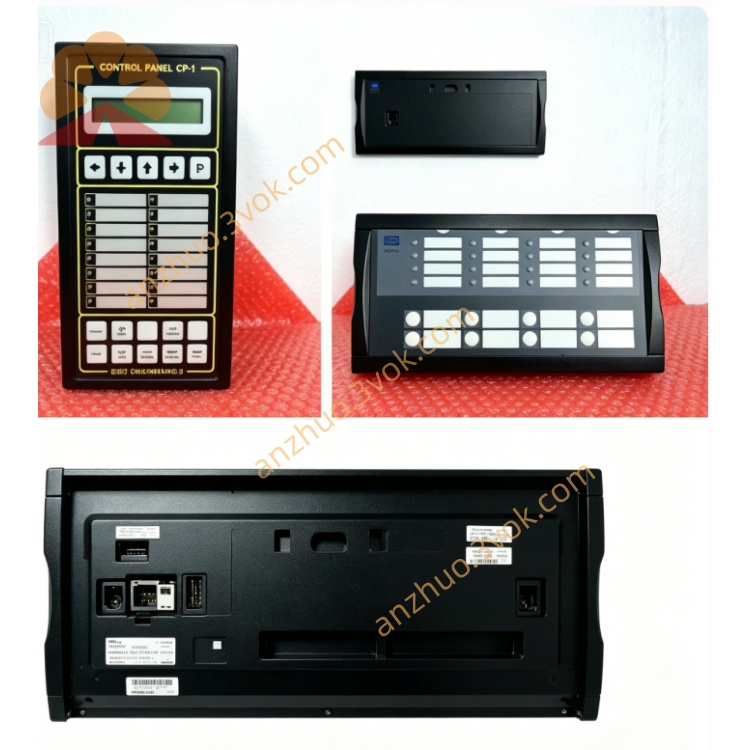
Description
1. Product Overview

2. Key Features
Core Controller for AWC 500: Central processing module for DEIF’s advanced wind turbine and industrial control system.
High-Speed Processor: 32-bit architecture for complex control algorithms and real-time data processing.
Multi-Protocol Communication:
Ethernet: 10/100 Mbps, TCP/IP, Modbus TCP, for remote monitoring and configuration.
CAN Bus: ISO 11898-2, for I/O expansion and device communication.
RS485: Modbus RTU, for serial communication with external devices.
USB: 2.0, service interface for firmware updates and configuration.
Extensive I/O Expansion: Compatible with AWC 500 I/O modules (IOM5-1, GPM5-1, etc.) for analog/digital input/output.
Real-Time Operating System: Ensures deterministic control and fast response times for critical applications.
Event & Alarm Logging: Comprehensive data logging for troubleshooting, compliance, and performance analysis.
Industrial & Renewable Certified: Designed to meet stringent environmental and reliability standards for wind and industrial use.
Hot-Swap Compatible: Supports replacement without system shutdown in AWC 500 rack systems.
3. Technical Specifications
3.1 Electrical Ratings
| Parameter | Specification |
|---|---|
| Model | PCM5-1 (Control Processor Module) |
| Manufacturer | DEIF A/S |
| Product ID | PCM5.1 |
| Processor | |
| – Architecture | 32-bit high-performance CPU |
| – Clock Speed | Up to 250 MHz |
| – Memory | Flash: 128 MB; RAM: 64 MB |
| Auxiliary Supply | |
| – Voltage | 24 VDC ±20% (18–32 VDC) |
| – Power Consumption | ≤30 W (full load) |
| – Fusing | 5 A slow-blow (internal) |
| Communication Interfaces | |
| – Ethernet | 10/100 Mbps, TCP/IP, Modbus TCP |
| – CAN Bus | 2 × CAN 2.0B, 125–1000 kbps |
| – RS485 | 1 × port, Modbus RTU, 19.2 kbps |
| – USB | 1 × USB 2.0 (service only) |
| – Backplane | AWC 500 internal bus (2.5 Mbps) |
3.2 Environmental & Mechanical
| Parameter | Specification |
|---|---|
| Operating Temperature | –30 °C to +70 °C (industrial/renewable) |
| Storage Temperature | –40 °C to +85 °C |
| Humidity | 5–95% RH non-condensing |
| Vibration | 2–13.2 Hz: ±1 mm; 13.2–100 Hz: ±1.0 g |
| Enclosure | IP20 (front/terminals); conformal coated PCB |
| Dimensions (W×H×D) | Standard AWC 500 module size (8TE) |
| Weight | Approx. 0.8 kg |
| Mounting | AWC 500 rack-mountable (horizontal) |
4. Application Scope
Wind Turbine Control: Core controller for AWC 500 wind turbine systems, managing pitch, yaw, and power regulation.
Renewable Energy Plants: Solar, hydro, and hybrid power plant control and monitoring.
Industrial Gensets: Advanced control for parallel gensets, load sharing, and power management.
Marine Power Systems: Offshore platform and vessel power management (certified for marine use)DEIF.
Process Automation: Control and monitoring of industrial processes requiring high reliability.
Retrofit Projects: Upgrade legacy control systems to AWC 500 with minimal wiring changes.
Remote Monitoring & Control: Ethernet connectivity for global system management and troubleshooting.
5. Installation & Wiring
5.1 Installation Requirements
Mounting: Install in an AWC 500 rack (horizontal) in a ventilated cabinet; ≥50 mm clearance top/bottom.
Environment: Avoid direct sunlight, moisture, corrosive gases, and excessive vibration.
ESD Protection: Use anti-static wristband when handling (static-sensitive PCB).
Cable Separation: Separate high-voltage cables from low-voltage communication cables by ≥10 cm.
5.2 Terminal Wiring (Simplified)
| Terminal Group | Description | Wire Gauge |
|---|---|---|
| Auxiliary Power | ||
| 1–2 | 24 VDC (+/−) | 1.5 mm² |
| 3 | Chassis ground (PE) | 2.5 mm² |
| Ethernet | ||
| 4–5 | RJ45: Ethernet link (TCP/IP) | CAT5e/CAT6 |
| CAN Bus | ||
| 6–7 | CAN1 (H/L) | 1.0 mm² (twisted-pair) |
| 8–9 | CAN2 (H/L) | 1.0 mm² (twisted-pair) |
| RS485 | ||
| 10–11 | RS485 (A/B) | 1.0 mm² (twisted-pair) |
Bus Cable: Use twisted-pair shielded cable for CAN/RS485; ground shield at one end only (PCM5-1 side).
Terminal Torque: Tighten terminals to 0.8–1.0 Nm to prevent loose connections and overheating.
Fusing: Protect 24 VDC supply with a 5 A slow-blow fuse.
5.3 Jumper & Switch Settings
Node Address: Set via rotary switch (1–F, hex); unique for all modules in the rack.
CAN Termination: Jumper-selectable 120 Ω termination (enable at bus ends).
RS485 Mode: Jumper for 2-wire (default) or 4-wire communication.
6. Front Panel & Operation
6.1 Front Panel Layout
LED Indicators (Left to Right)
POWER: On = 24 VDC supply OK.
RUN: Flashing = Normal operation; Solid = Fault/trip.
COMM: Flashing = Communication active; Solid = Communication fault.
ETHERNET: Flashing = Ethernet link active; Solid = Link fault.
ALARM: On = Active alarm; Flashing = Unacknowledged alarm.

6.2 Startup & Configuration
Physical Installation: Insert PCM5-1 into AWC 500 rack; connect 24 VDC and communication wiring.
Switch/Jumper Setup: Set node ID; enable CAN termination if needed.
Power On: Apply 24 VDC; POWER LED on; RUN LED flashes; system initializes.
PC Tool Connection:
USB: Connect PC to USB port; launch DEIF configuration software; verify communication.
Ethernet: Connect PC to Ethernet port; enter default IP (192.168.2.21); log in (user: admin, password: admin).
Basic Configuration:
Set Network Parameters: IP address, subnet mask, gateway.
Configure Communication Protocols: Enable Modbus TCP/RTU, set baud rates.
Set System Parameters: Time, date, and logging options.
Configure I/O Modules: Assign and calibrate connected IOM5-1/GPM5-1 modules.
6.3 Normal Operation
RUN LED: Flashes every 1 second (normal operation).
COMM LED: Flashes every 0.5 seconds (active communication).
ETHERNET LED: Flashes every 0.5 seconds (active link).
ALARM LED: Off (no alarms); On if warning threshold exceeded.
7. Safety Precautions
High Voltage Hazard: Only qualified electrical personnel may install/service. Disconnect all power sources before wiring.
ESD Sensitivity: Static electricity can damage internal PCB. Use anti-static wristband and grounded ESD mat.
No Unauthorised Modification: Do not open the enclosure or modify internal circuits. Tampering voids warranty and may cause unsafe operation.
Environmental Limits: Do not operate outside –30 °C to +70 °C.
8. Maintenance & Storage
8.1 Regular Maintenance (Every 6 Months)
Visual Inspection: Check for loose terminals, damaged wiring, corrosion, or overheating signs.
Cleaning: Wipe front panel with dry lint-free cloth; no liquid cleaners.
LED Check: Verify POWER/RUN/COMM/ETHERNET/ALARM LEDs operate correctly.
Terminal Tightness: Retorque all terminals to 0.8–1.0 Nm.
Firmware Update: Check for latest firmware via DEIF website; update if necessary.
Event Log Backup: Download and save event log for troubleshooting.
8.2 Storage Guidelines
Packaging: Store in original anti-static packaging with desiccant.
Environment: 10–30 °C, 30–70% RH, dry, clean, and dust-free.
Protection: Avoid direct sunlight, extreme temperatures, and mechanical shock/vibration.
Duration: Shelf life ≤2 years. Inspect for ESD damage and test basic functions before use if stored longer.
9. Troubleshooting
| Fault Phenomenon | Possible Cause | Solution |
|---|---|---|
| POWER LED Off | No 24 VDC / blown internal fuse | Check power wiring; replace 5 A fuse. |
| RUN LED Solid (Fault) | System initialization error / hardware fault | Reboot system; contact DEIF service. |
| COMM LED Solid (Fault) | Wrong node ID / wiring reversed / cable fault | Set unique ID; correct polarity; replace cable. |
| ETHERNET LED Off | Cable fault / incorrect IP configuration / link down | Replace cable; verify IP settings; restart network. |
| ALARM LED On | System warning / I/O module fault | Check event log; inspect connected modules. |
| No Communication with PC | USB/Ethernet cable fault / incorrect software setting | Replace cable; verify software configuration. |
10. Warranty & Disclaimer
Model: PCM5-1 Control Processor Module (AWC 500).
Warranty Period: 24 months from delivery date (normal installation/use per manual).
Warranty Exclusions: Misuse, overvoltage, lightning, water ingress, unauthorised modification, improper maintenance.
Specifications Subject to Change: Manufacturer reserves the right to update specifications without prior notice.
Liability Limitation: Manufacturer is not liable for indirect or consequential damages (e.g., downtime, lost revenue).
Documentation Version: 1.0 (2026); latest manual and firmware available at www.deif.com.
Get a Quote