
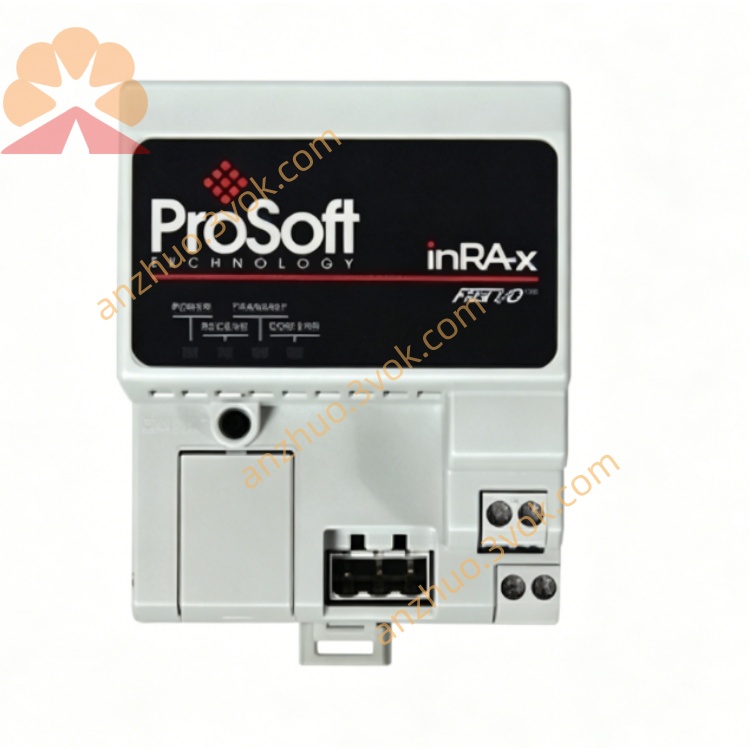
5201-104S-103M
Description
1. Product Overview
Part Number: 5201‑104S‑103M
Manufacturer: ProSoft Technology (ProLinx 5000 Series)
Product Type: DIN‑rail mounted protocol gateway
Function: Bidirectional protocol conversion between
IEC 60870‑5‑104 Server (Ethernet) and IEC 60870‑5‑103 Master (serial).
Enables seamless data exchange between 104‑based SCADA/EMS and 103‑based protection/control devices.
Protocols:
Ethernet: IEC 60870‑5‑104 Server (104S)
Serial: IEC 60870‑5‑103 Master (103M)
2. Key Features
IEC 60870‑5‑104 Server (Ethernet, TCP/IP)
IEC 60870‑5‑103 Master (serial, RS‑232/485)
Supports 104: ASDU types, cyclic data, spontaneous events, time synchronization
Supports 103: general interrogation, data polling, control commands, disturbance records
Ethernet: 10/100 Mbps, auto‑MDI‑X, up to 32 concurrent 104 clients
Serial: RS‑232/485, baud 1200–115.2 kbps, configurable data/stop/parity
Data mapping: points, commands, and events mapped between 104 and 103
Time synchronization: 104 time sync to 103 devices
Isolated Ethernet and serial ports
Industrial DIN‑rail mount, compact size
LED indicators for power, run, Ethernet, serial, fault
Wide temperature range for power utility and harsh environments
3. Technical Specifications
3.1 Power
Voltage: 18–32 VDC (24 VDC nominal)
Current: ≤600 mA @ 24 VDC
Power consumption: ≤15 W
3.2 IEC 60870‑5‑104 Server (Ethernet)
Interface: 10/100Base‑T (RJ45)
Protocol: IEC 60870‑5‑104 Server
Concurrent clients: up to 32
ASDU address range: 0–65535
Cyclic update: 1 ms–5 min configurable
Supports: monitored data, setpoints, commands, time sync
3.3 IEC 60870‑5‑103 Master (Serial)
Interface: RS‑232 / RS‑485 (software selectable)
Baud rate: 1200, 2400, 4800, 9600, 19.2k, 38.4k, 57.6k, 115.2k
Data bits: 8; Stop bits: 1; Parity: None/Even/Odd
Protocol: IEC 60870‑5‑103 Master
Slave stations: up to 31 (multi‑drop RS‑485)
Functionality: general interrogation, data polling, trip/close commands, disturbance record retrieval
3.4 Environmental
Operating temp: −20 °C to +60 °C
Storage temp: −40 °C to +85 °C
Humidity: 5–95% RH, non‑condensing
Vibration: 5 g, 10–150 Hz
Shock: 30 g (operational)
3.5 Physical
Mounting: standard DIN rail
Dimensions: approx 125 × 80 × 30 mm
Weight: approx 0.48 kg
Certifications: CE, UL/cUL, Class 1 Div 2 (optional)
4. LED Indicators
PWR: Power – steady = OK
RUN: Module – flashing = running normally
ETH: Ethernet – flashing = link/activity
SER: Serial (103) – flashing = active communication
ERR: Fault – ON = configuration/communication error
5. Installation & Wiring
Mount gateway on DIN rail in cabinet.
Connect 24 VDC power (observe polarity).
Connect Ethernet cable to RJ45 for 104 SCADA connection.
Wire serial port to 103 devices (RS‑485 recommended for multi‑drop).
Set network parameters (IP, subnet, gateway) via configuration software.
Configure 104 server parameters (ASDU address, cyclic intervals).
Configure 103 master parameters (slave addresses, baud rate, polling list).
Map 104 data points/commands to 103 data objects.
Download configuration; verify LED status and data exchange.
6. Data Mapping
Map 104: single points, double points, measured values, setpoints, commands
Map 103: information elements, measured values, commands, disturbance records
Time synchronization: 104 time distributed to 103 devices
Configurable fault states: hold last value or set to zero on timeout
7. Typical Applications
Power utility SCADA: connect 104‑based control centers to 103‑based protection relays
Substation automation: integrate legacy 103 IEDs into modern 104 networks
Oil & gas, water treatment: bridge 104 SCADA and 103 field devices
Renewable energy plants: protocol conversion for grid‑side communication
8. Safety Notes
Disconnect power before installation/wiring.
Use shielded cables for both Ethernet and serial.
Do not exceed voltage and temperature ratings.
Terminate RS‑485 bus at both ends.
Configuration must be performed by qualified personnel.
Get a Quote