
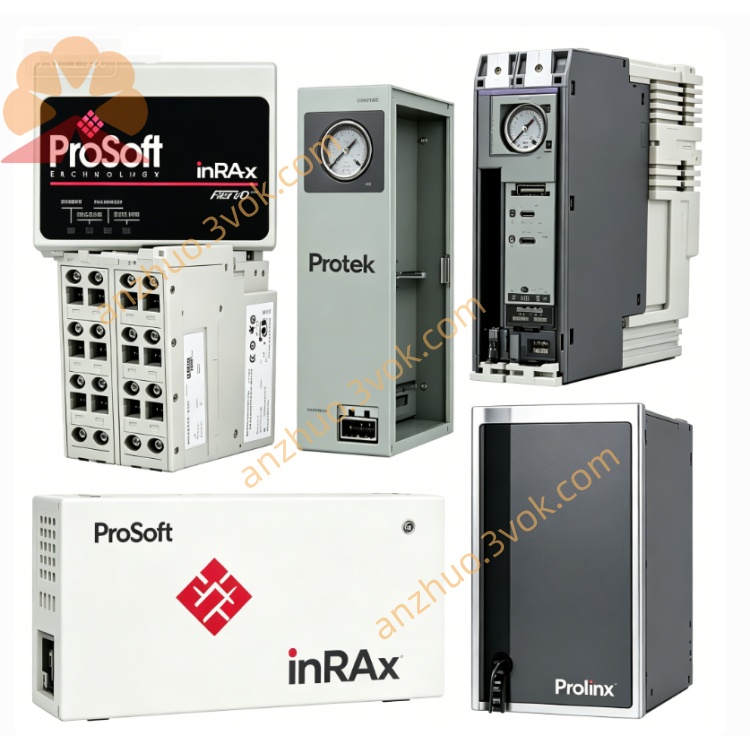
ProSoft MVI69-DNP Product Description
Description
ProSoft MVI69-DNP Product Description
MVI69-DNP (DNP 3.0 Master/Slave Network Interface Module) is a DNP 3.0 master station / slave station communication module specifically designed by ProSoft for the Rockwell CompactLogix / MicroLogix 1500 platform. It provides 2 independent, software-configurable RS-232/422/485 serial ports, supports DNP 3.0 Level 2 and some Level 3 functions, and can act as a master station to actively poll field devices, or as a slave station to respond to SCADA system instructions, enabling seamless integration of CompactLogix with DNP devices in the power, water conservancy, and oil and gas industries.
I. Model Interpretation
MVI69: Specialized module for CompactLogix / MicroLogix 1769 platform
DNP: DNP 3.0 (Distributed Network Protocol) Distributed Network Protocol
Core Positioning: Dual ports, independent, master/slave dual mode, DNP 3.0 Level 2/3, event triggering, industrial-level isolation, SCADA dedicated
II. Core Hardware Specifications
Compatible Platforms:
CompactLogix: L20, L30, L35, L43, L45 (L43/L45 require installation in the first 2 slots of the rack) MicroLogix 1500 LRP
Incompatibility: 1769-L23E-QBFC1B, 1769-L16x, 1769-L18x
Slot occupation: Single slot (standard 1769 size)
Backplane power consumption: 800mA @ 5.1VDC
Serial port application (2 ports: P1 / P2):
Electrical standard: RS-232/RS-422/RS-485 software configurable
Isolation voltage: 1500Vrms optically isolated
Mode: Full duplex / Half duplex
Baud rate: 300bps ~ 115.2kbps
Connector: RJ45 (with RJ45 → DB9 adapter)
Flow control: Hardware handshake (RTS/CTS), supports Modem, radio
Configuration port (CFG): RS-232 (RJ45), used for module configuration, firmware upgrade
Internal database: Maximum 4000 register (users can customize data mapping)
Master station command: 300 user-defined DNP commands
Slave station connection: Up to 40 slave station devices
Event cache: 400 analog input events, 1000 digital input events
Data point support:
Analog input (AI): 2000 points
Analog output (AO): 500 points
Digital input (BI): 2000 points
Digital output (BO): 500 points
LED status: OK, ERR, P1, P2, BAT five groups of indicator lights
Operating temperature: 0°C ~ +60°C
Storage temperature: -40°C ~ +85°C
Humidity: 5% ~ 95% (no condensation)
Certification: CE, UL, cURus, RoHS, ATEX Class I Div 2
III. Core Functions and Performance
1. DNP 3.0 protocol support (core advantage)
Dual mode operation:
Master station mode: Active polling of DNP slave station devices (RTU, instrument, protection device), supports 300 user commands
Slave station mode: Respond to SCADA master station instructions, provide data upload and control execution
Protocol level: DNP 3.0 Subset Level 2 + Partial Level 3 functions
Event triggering:
Change report (RBE): Automatically report when data change exceeds the dead zone
Active upload (Unsolicited Response): Event pushed to the master station actively
Timestamp: All events with precise time stamp (supports SNTP synchronization)
Data classification: Class 0/1/2/3 data classification, optimizes SCADA polling efficiency
Dead zone control: Analog dead zone can be configured, reduces invalid communication
Cold / Hot start: Supports module cold start, hot start, no loss of configuration
Redundant slave station: Dual slave station port redundancy, automatic switching in case of failure
2. Serial port communication characteristics
Electrical isolation: 1500Vrms isolation, anti-interference, protection of PLC
Multi-machine network:
RS-485: 32-point multi-point bus
RS-422: Full-duplex point-to-point
RS-232: Point-to-point (≤15m)
Remote communication: Supports Modem dial-up, radio station, GPRS remote DNP communication
Data format: 7/8 data bits, 1/1.5/2 stop bits, odd / even / no parity
3. Backplane high-speed communication (PLC interaction)
Asynchronous exchange: Module and PLC data interaction is independent of the DNP network, does not occupy PLC scanning time
Data mapping: 4000-byte database directly mapped to PLC controller label
Interaction mode: Periodic I/O data mirroring
Ladder diagram AOI, MSG instructions for control
Real-time reporting of status, error codes, and events
Transmission delay: < 1ms (backplane high-speed bus)
4. Configuration and Diagnosis
Configuration software: ProSoft Configuration Builder (PCB)
Visual configuration of ports, master station commands, data points, dead zones, events
Configuration file download, backup, batch copying
Online diagnosis:
Port status, communication traffic, error count
Master station polling status, slave station response monitoring
Event log, timestamp, fault code
Battery status, module health monitoring
Four. Core Features and Advantages
1. Seamless integration of AB systems
Native compatibility: Specifically designed for CompactLogix/MicroLogix, single slot, backplane power supply
Plug-and-play: PLC automatically recognizes as an I/O module, no additional programming required
Tag mapping: Direct conversion of DNP data to PLC tags, simplifying program development
Program support from ProSoft Technology Inc: Studio 5000 AOI, ladder diagram routines, configuration examples
2. Professional-level DNP 3.0 functions
Event-driven: RBE + active upload, significantly reducing network load
Hierarchical data: Class 0/1/2/3 optimized SCADA polling, improving system response
Mass data points: 2000 AI/2000 BI/500 AO/500 BO, meeting requirements for large-scale SCADA
Event caching: Caches events during power loss or communication interruption, and retransmits upon recovery
Time synchronization: Supports SNTP network time synchronization, events are precisely traceable
3. Industrial-grade reliability
Photoelectric isolation: 1500Vrms isolation against surges, interference, and ground potential difference
Independent operation: Module failure does not affect the PLC host
Power loss protection: Built-in battery, configuration, events, timestamps not lost for 10 years
Wide temperature design: 0~60℃, suitable for harsh environments in power, water conservancy, oil and gas
Redundant ports: Dual slave station ports redundancy, zero interruption for critical applications
4. Efficient development, easy maintenance
Visual configuration: Drag-and-drop configuration in PCB software, rapid deployment
Online debugging: Real-time monitoring of events, communication status, quick fault location
Batch application of ProSoft Technology Inc: One-click copy of configuration files, rapid production at multiple sites
Remote diagnosis: Supports remote configuration, firmware upgrade, event viewing
Five. Typical Application Scenarios
Power SCADA system: Substations, distribution networks, power plants, CompactLogix connected to DNP 3.0 SCADA
Water conservancy monitoring: Reservoirs, gates, pumping stations, water quality monitoring, DNP equipment integration
Oil and gas long-distance transportation: Pipeline pressure, flow, valve control, DNP remote monitoring
Municipal public utilities: City water supply, gas, sewage SCADA systems
Industrial energy management: Factory power monitoring, intelligent instruments, power quality analysis
Upgrade of outdated systems: Old equipment without DNP interface connected to modern SCADA network
Remote wireless monitoring: Through GPRS, satellite, radio to achieve DNP communication at remote sites
Six. Summary
MVI69-DNP is the industrial standard solution for DNP 3.0 communication on the CompactLogix platform. With dual independent isolated serial ports, master/slave station dual mode, full functionality of DNP 3.0 Level 2/3, event-triggered active upload, 4000-byte large data buffer, 300 master station commands, 40 slave station connections, seamless compatibility of the entire AB series, industrial-grade reliability, and visual configuration as its core advantages, it is specially designed for SCADA system integration, remote monitoring, and upgrading of old equipment in industries such as power, water conservancy, oil and gas, and municipal public utilities. It is the preferred communication module for achieving interconnection between Rockwell PLC and DNP 3.0 network.
Get a Quote