
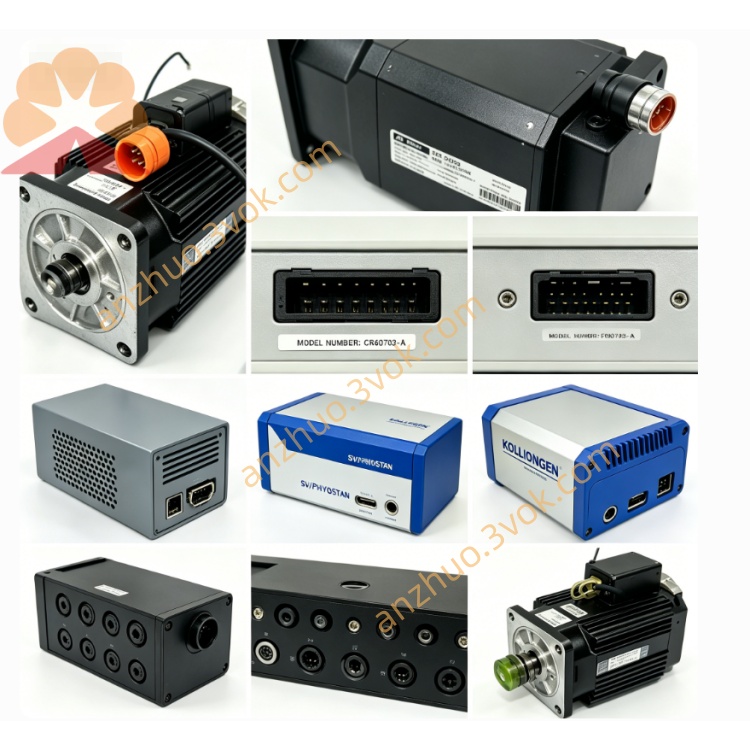
Kolmorgen SR1030B62 Servo Driver Detailed Product Description
Description
Kolmorgen SR1030B62 Servo Driver Detailed Product Description
I. Product Overview
SR1030B62 is a 15A level, 230V standard digital servo driver of the ServoStar SR series, belonging to the B series basic hardware version (not 2G enhanced), with configuration code 62 defined as: DeviceNet bus, incremental encoder feedback, standard I/O, built-in regenerative braking, no STO safety function. It is specifically designed for medium-power servo systems of 3.0–5.5kW, using DeviceNet fieldbus communication, suitable for traditional automation production lines, machines, packaging, material handling and other industrial scenarios that require bus control + stable and reliable operation, with core advantages of mature architecture, high compatibility and low cost.
II. Complete Model Interpretation
S - ServoStar SR series servo driver
R - Supports Resolver + Encoder dual feedback hardware interface
10 - Basic current level (15A continuous output, SR series 10-digit represents medium-large power)
30 - Three-phase 230VAC input, standard vector control (30 = 230V 15A basic version)
B - B series basic hardware (standard performance, not 2G second-generation enhanced)
62 - Function configuration code (core definition)
6 - Communication: DeviceNet bus (DS301/DS402) + RS-232 debugging
2 - Feedback + I/O + functions: incremental encoder feedback, standard I/O (8DI/4DO), built-in regenerative braking, no STO
III. Core Electrical Parameters
1. Power Supply and Power Specifications
Input power supply: three-phase 230VAC ±10%, 50/60Hz (bus 320–460VDC)
Control power supply: DC 24V ±10%, 1.2A (external auxiliary power supply)
Continuous output current: 15.0A RMS (S1 continuous, 40°C)
Peak output current: 45.0A RMS (3× rated, continuous ≤5s)
Applicable motor power: 3.0–5.5kW (230V level brushless servo motor)
Carrier frequency: 8–12kHz (configurable, low-noise stable operation)
Control mode: position / speed / torque three-loop full digital vector control
Instruction input: DeviceNet bus, ±10V analog quantity, pulse / direction (three modes compatible)
2. Feedback and Interfaces
Feedback support: incremental encoder (2500–8192ppr), 12-pole resolver
Compatible feedback: EnDat/Hiperface/SSI absolute value encoder (requires software adaptation)
Communication interface: DeviceNet (125kbps–500kbps), RS-232 (debugging)
Digital I/O: 8DI (24V optocoupler isolation), 4DO (open collector) (standard configuration)
Analog I/O: 1×±10V instruction, 1×0–10V monitoring output
Braking function: Built-in regenerative braking unit (supports external braking resistor, ≥1.0kW)
Protection functions: overvoltage, undervoltage, overcurrent, short circuit, overload, overheat, encoder break, over-speed, I/O failure
3. Dynamic Performance and Accuracy
Current loop response: ≤120μs
Speed loop response: ≤1.2ms
Position loop response: ≤2.5ms Speed range: 1:6000 (≤ 1 rpm, low speed stable without jitter)
Positioning accuracy: ±1, encoder pulses (8192 ppr)
Overheating protection: Built-in NTC, triggered by 85°C for reduction or shutdown
IV. Physical and Mechanical Specifications
Dimensions: 300mm × 95mm × 200mm (standard rack-mounted, SR series standard dimensions)
Weight: 3.3kg (approximately 6.6lb)
Protection level: IP00 (installed in control cabinet)
Installation method: Vertical wall-mounted (4-point fixation, optimized air duct)
Cooling method: Forced air cooling (single fan, efficient heat dissipation)
Installation spacing: ≥ 5cm of ventilation space around
Heat dissipation power: ≤ 75W (rated load)
V. Environment and Certification
Operating temperature: 0°C ~ +40°C (no reduction)
Storage temperature: -20°C ~ +85°C
Relative humidity: 5%–90% RH (no condensation)
Vibration: 2.5g (10–2000Hz)
Impact: 15g (11ms)
Certification standards: CE, UL 508, cULus, EN 61800-3
VI. Core Technical Characteristics
1. Full digital vector control (B series standard architecture)
32-bit DSP space vector algorithm, four-quadrant reversible operation, regenerative energy feedback
Adaptive parameter self-tuning: automatic identification of motor parameters, inertia identification, friction compensation, vibration suppression
Electronic gearing: programmable gear ratio (1:1 ~ 1024:1), supports synchronous following motion
Slot torque suppression: low-speed pulsation compensation, ≤ 1 rpm stable operation, suitable for precise positioning
Wide voltage compatibility: stable adaptation to 230V industrial grid, strong tolerance to bus fluctuations
2. DeviceNet bus advantages
Mature industrial bus: widely used globally, multi-axis synchronization, remote diagnosis, seamless connection with PLC
Communication rate: 125kbps–500kbps adaptive, strong real-time performance, excellent anti-interference
Network topology: supports bus type and tree type topology, up to 63 nodes, simplified wiring
Diagnostic function: real-time communication status monitoring, fault code upload, remote debugging and maintenance
3. B62 Configuration Features
Three-mode instruction compatibility: DeviceNet bus, analog quantity, pulse instruction, compatible with old and new systems
Dual feedback hardware support: incremental encoder + resolver, flexible switching on-site
Standard I/O sufficient: 8DI/4DO meets basic logic such as limit, emergency stop, enable, status feedback
Built-in regenerative braking: no need for external braking drive, cost reduction and simplified wiring
Minimal stable architecture: no complex safety functions, low failure rate, simple debugging, convenient maintenance
VII. Compatible Motors and Typical Applications
1. Compatible Kohmorgen motors (230V 15A class)
AKM series: AKM42/43/51/52 (3.0–5.5kW, 230V)
Goldline series: T156/T166 (15A winding, 230V)
MT series: MT402/404/406 (medium power 230V)
Third-party: 3.0–5.5kW, 15A RMS, 230V class brushless servo motors
2. Typical application fields
Traditional automation production lines: assembly line, handling line, inspection equipment (controlled by DeviceNet bus)
Machine tools: CNC turning / milling / grinding, machining centers (feed axis bus control)
Packaging / printing: die-cutting, slitting, laminating, offset printing (high-precision synchronization)
Material handling: medium-sized AGV, hoist, winch (high torque control) Textile / Rubber & Plastic: Printing and dyeing machines, extrusion machines, injection molding machines (torque / tension closed loop)
Electronic Manufacturing: Plug-in machines, surface mount machines, dispensing machines (precise positioning)
VIII. Installation and Commissioning Key Points
Installation: Vertical wall-mounted, smooth air duct, dust-free and corrosion-free environment
Cabling: Power / feedback / control shielded separation (spacing ≥ 10cm), 360° shielded grounding
Power Supply: Three-phase 230V stable, 24V filtering, braking resistor ≥ 1.0kW
Commissioning: Workbench connects RS-232, automatic calibration, DeviceNet configuration, limit / emergency stop test
Maintenance: Regular dust cleaning, check fans, tighten wiring
Safety: Power off ≥ 8 minutes discharge,严禁 plug-in or unplugging while powered on
IX. Notes
SR1030B62 is a SR series 15A 230V DeviceNet standard drive. B series basic hardware + DeviceNet bus + built-in braking combination. It has strong compatibility, high stability and the lowest cost in traditional medium-power automation systems. It is mainly for spare parts, maintenance, refurbishment, and upgrading of old equipment in the market. It is a cost-effective and reliable choice for 3.0–5.5kW DeviceNet bus servo. The parameters are based on the nameplate and the original factory manual. Installation and debugging must be carried out by professional engineers.
Get a Quote