
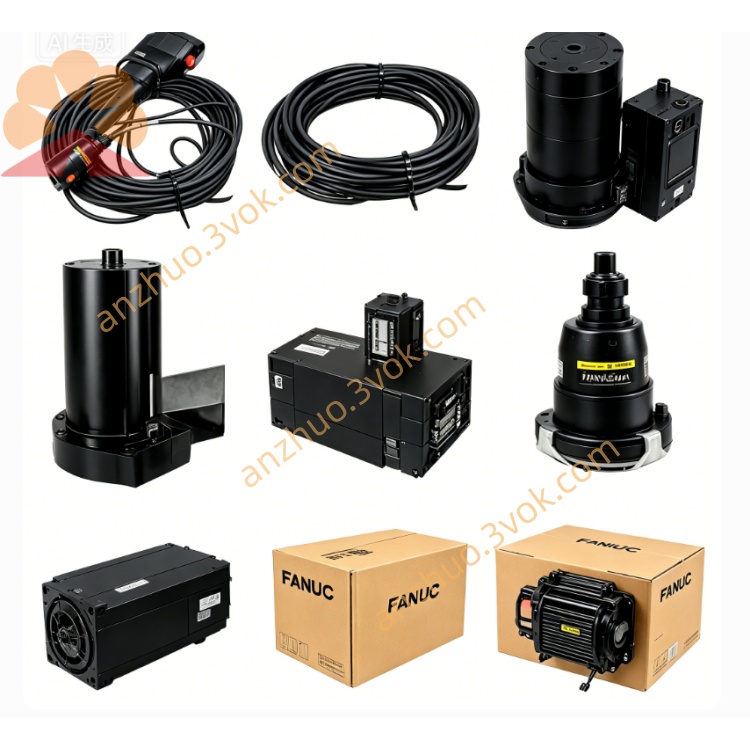
A06B-6066
Description
FANUC A06B-6066 Series C Series AC Servo Amplifier
1.
FANUC A06B-6066 Series C Series AC Servo Amplifier
1. General Description
2. Product Features
Type: Digital AC servo amplifier (single-axis/dual-axis, C-series)
Housing: Heavy-duty yellow metal enclosure, IP20 protection, durable for industrial environments
Core Boards: Equipped with A20B series control boards (e.g., A20B-2900-0610) and power boards (e.g., A20B-1004-0850)
Power Supply: Three-phase AC 200–230V, 50/60Hz
Control Modes: Closed-loop control of position, velocity, and current; PWM-based current control
Feedback: Compatible with FANUC pulse encoders for position and speed feedback
Protection Functions: Overcurrent, overvoltage, undervoltage, overheating, overload, regenerative discharge, and magnetic contactor welding protection
Status Indicators: Onboard LEDs (5V, DRDY, HV, HC, LV, DC) for real-time status and fault diagnosis
Cooling: Integrated variable-speed cooling fan for stable operation under heavy loads
Weight: Approx. 5.6 kg (single-axis); approx. 10.0 kg (dual-axis)
Status: Discontinued by FANUC; available as new old stock or refurbished units
Temperature Range: Operating 0°C to +55°C; storage -20°C to +60°C
3. Application Scope
Compatible Motors: FANUC 0S, 5S, 10S, 20S, 30S, αiS, βiS, 5L (laser), 0T/3000, 5-F/2000 series AC servo motors
Compatible CNC Systems: FANUC Series 0-C, 15A, 16A, 18A, 21A and other legacy systems
Applicable Machines: CNC lathes, milling machines, machining centers, grinding machines, boring machines, and automation production lines
Main Functions: Precise servo axis motion control, spindle drive (for specific models), and old machine tool retrofitting
4. Common Models
A06B-6066-H004: Single-axis amplifier, compatible with 0S/5S/10S/20S series motors
A06B-6066-H006: Single-axis amplifier (80A), for 30S/5L series high-power motors
A06B-6066-H233: Dual-axis amplifier (L/M axes), 13.2A rated current, for 5S/20S series motors
A06B-6066-H246: Dual-axis amplifier, enhanced regenerative discharge capability, for high-duty-cycle applications
5. Installation Instructions
Power Off: Perform all installation and wiring with all power disconnected to avoid electric shock or component damage.
Mounting: Install vertically on a rigid, vibration-free surface in the electrical cabinet; maintain 100mm clearance around the unit for ventilation and 50mm clearance above for fan airflow.
Wiring: Connect three-phase AC power (L1/L2/L3) to the power terminal block; connect motor power cables (U/V/W) and encoder cables to the corresponding connectors; ensure tight and secure connections.
Grounding: Connect the amplifier chassis and cable shields to the system ground with a ground resistance of ≤4Ω to reduce electromagnetic interference and prevent electric shock.
Communication: Connect fiber-optic cables between the amplifier and CNC system for high-speed digital communication; ensure correct Tx/Rx polarity.
Inspection: Verify all connections, grounding, and clearance before powering on; check for loose terminals or cable damage.
6. Wiring Requirements
Power Cables: Use FANUC-certified power cables with a current rating ≥150% of the amplifier’s rated current; avoid undersized cables to prevent overheating.
Signal Cables: Use shielded twisted-pair encoder cables and control signal cables; route signal cables separately from high-power cables with a minimum 20mm spacing to reduce crosstalk.
Grounding: Ground cable shields at both ends; connect the amplifier chassis to the system ground busbar with a short, thick ground wire.
Pin Assignment: Strictly follow FANUC’s official wiring diagram and pin assignment; do not alter wiring order or modify internal circuits.
Cable Protection: Keep cables away from heat sources (e.g., transformers, resistors) and avoid sharp bends or tension to prevent cable insulation damage.
7. Working Environment
Operating Temperature: 0°C to +55°C (ambient, non-condensing)
Storage Temperature: -20°C to +60°C
Relative Humidity: ≤80% (non-condensing)
Vibration Resistance: Maximum 5G (10–500Hz)
Altitude: Up to 1000 meters above sea level (derate 1% per 100m above 1000m)
Environment: Avoid corrosive gases (e.g., chlorine, sulfur dioxide), oil mist, conductive dust, and direct sunlight; keep the electrical cabinet clean and dry.
8. Maintenance Instructions
Periodic Inspection: Quarterly power-off inspection of connections, grounding, and ventilation; check for dust accumulation, loose terminals, or cable damage; inspect cooling fan operation and clean fan blades.
Cleaning: Clean dust and oil from the amplifier surface, ventilation holes, and fan with a dry soft cloth or compressed air (low pressure, ≤0.5MPa); keep the unit clean and dry to prevent overheating.
Component Check: Regularly check capacitors (for swelling or leakage), resistors (for discoloration), and circuit boards (for burns or corrosion); replace faulty components promptly with FANUC-certified parts.
Fan Maintenance: Inspect the cooling fan monthly for noise, vibration, or speed abnormalities; replace worn fans with the same model to ensure cooling efficiency.
Prohibition of Unauthorized Disassembly: Do not disassemble the amplifier internal structure or modify circuits without professional guidance; internal damage will void performance and safety, and may cause equipment failure or personal injury.
9. Safety Precautions
Qualified Personnel: Installation, wiring, maintenance, and repair must be performed by qualified electrical and servo technicians with knowledge of FANUC CNC systems and servo amplifiers.
No Hot Plugging: Never plug or unplug cables (power, encoder, communication) with power on; signal transients may damage the amplifier, motor, or CNC system, and cause electric shock.
Reliable Grounding: Ensure the entire system (amplifier, motor, CNC) is reliably grounded to minimize EMI, prevent electric shock, and ensure stable operation.
Overload Prevention: Do not exceed the amplifier’s rated load or continuous duty cycle to avoid permanent damage to power components or overheating.
Fault Handling: In case of alarms (e.g., overcurrent, overvoltage, overheating), immediately power off the system, troubleshoot the cause, and resolve the issue before restarting; do not operate the amplifier with persistent faults.
Environmental Safety: Keep the amplifier away from flammable materials and humid, high-temperature environments; ensure the electrical cabinet is locked and accessible only to authorized personnel.
2. Product Features
Type: Digital AC servo amplifier (single-axis/dual-axis, C-series)
Housing: Heavy-duty yellow metal enclosure, IP20 protection, durable for industrial environments
Core Boards: Equipped with A20B series control boards (e.g., A20B-2900-0610) and power boards (e.g., A20B-1004-0850)
Power Supply: Three-phase AC 200–230V, 50/60Hz
Control Modes: Closed-loop control of position, velocity, and current; PWM-based current control
Feedback: Compatible with FANUC pulse encoders for position and speed feedback
Protection Functions: Overcurrent, overvoltage, undervoltage, overheating, overload, regenerative discharge, and magnetic contactor welding protection
Status Indicators: Onboard LEDs (5V, DRDY, HV, HC, LV, DC) for real-time status and fault diagnosis
Cooling: Integrated variable-speed cooling fan for stable operation under heavy loads
Weight: Approx. 5.6 kg (single-axis); approx. 10.0 kg (dual-axis)
Status: Discontinued by FANUC; available as new old stock or refurbished units
Temperature Range: Operating 0°C to +55°C; storage -20°C to +60°C
3. Application Scope
Compatible Motors: FANUC 0S, 5S, 10S, 20S, 30S, αiS, βiS, 5L (laser), 0T/3000, 5-F/2000 series AC servo motors
Compatible CNC Systems: FANUC Series 0-C, 15A, 16A, 18A, 21A and other legacy systems
Applicable Machines: CNC lathes, milling machines, machining centers, grinding machines, boring machines, and automation production lines
Main Functions: Precise servo axis motion control, spindle drive (for specific models), and old machine tool retrofitting
4. Common Models
A06B-6066-H004: Single-axis amplifier, compatible with 0S/5S/10S/20S series motors
A06B-6066-H006: Single-axis amplifier (80A), for 30S/5L series high-power motors
A06B-6066-H233: Dual-axis amplifier (L/M axes), 13.2A rated current, for 5S/20S series motors
A06B-6066-H246: Dual-axis amplifier, enhanced regenerative discharge capability, for high-duty-cycle applications
5. Installation Instructions
Power Off: Perform all installation and wiring with all power disconnected to avoid electric shock or component damage.
Mounting: Install vertically on a rigid, vibration-free surface in the electrical cabinet; maintain 100mm clearance around the unit for ventilation and 50mm clearance above for fan airflow.
Wiring: Connect three-phase AC power (L1/L2/L3) to the power terminal block; connect motor power cables (U/V/W) and encoder cables to the corresponding connectors; ensure tight and secure connections.
Grounding: Connect the amplifier chassis and cable shields to the system ground with a ground resistance of ≤4Ω to reduce electromagnetic interference and prevent electric shock.
Communication: Connect fiber-optic cables between the amplifier and CNC system for high-speed digital communication; ensure correct Tx/Rx polarity.
Inspection: Verify all connections, grounding, and clearance before powering on; check for loose terminals or cable damage.
6. Wiring Requirements
Power Cables: Use FANUC-certified power cables with a current rating ≥150% of the amplifier’s rated current; avoid undersized cables to prevent overheating.
Signal Cables: Use shielded twisted-pair encoder cables and control signal cables; route signal cables separately from high-power cables with a minimum 20mm spacing to reduce crosstalk.
Grounding: Ground cable shields at both ends; connect the amplifier chassis to the system ground busbar with a short, thick ground wire.
Pin Assignment: Strictly follow FANUC’s official wiring diagram and pin assignment; do not alter wiring order or modify internal circuits.
Cable Protection: Keep cables away from heat sources (e.g., transformers, resistors) and avoid sharp bends or tension to prevent cable insulation damage.
7. Working Environment
Operating Temperature: 0°C to +55°C (ambient, non-condensing)
Storage Temperature: -20°C to +60°C
Relative Humidity: ≤80% (non-condensing)
Vibration Resistance: Maximum 5G (10–500Hz)
Altitude: Up to 1000 meters above sea level (derate 1% per 100m above 1000m)
Environment: Avoid corrosive gases (e.g., chlorine, sulfur dioxide), oil mist, conductive dust, and direct sunlight; keep the electrical cabinet clean and dry.
8. Maintenance Instructions
Periodic Inspection: Quarterly power-off inspection of connections, grounding, and ventilation; check for dust accumulation, loose terminals, or cable damage; inspect cooling fan operation and clean fan blades.
Cleaning: Clean dust and oil from the amplifier surface, ventilation holes, and fan with a dry soft cloth or compressed air (low pressure, ≤0.5MPa); keep the unit clean and dry to prevent overheating.
Component Check: Regularly check capacitors (for swelling or leakage), resistors (for discoloration), and circuit boards (for burns or corrosion); replace faulty components promptly with FANUC-certified parts.
Fan Maintenance: Inspect the cooling fan monthly for noise, vibration, or speed abnormalities; replace worn fans with the same model to ensure cooling efficiency.
Prohibition of Unauthorized Disassembly: Do not disassemble the amplifier internal structure or modify circuits without professional guidance; internal damage will void performance and safety, and may cause equipment failure or personal injury.
9. Safety Precautions
Qualified Personnel: Installation, wiring, maintenance, and repair must be performed by qualified electrical and servo technicians with knowledge of FANUC CNC systems and servo amplifiers.
No Hot Plugging: Never plug or unplug cables (power, encoder, communication) with power on; signal transients may damage the amplifier, motor, or CNC system, and cause electric shock.
Reliable Grounding: Ensure the entire system (amplifier, motor, CNC) is reliably grounded to minimize EMI, prevent electric shock, and ensure stable operation.
Overload Prevention: Do not exceed the amplifier’s rated load or continuous duty cycle to avoid permanent damage to power components or overheating.
Fault Handling: In case of alarms (e.g., overcurrent, overvoltage, overheating), immediately power off the system, troubleshoot the cause, and resolve the issue before restarting; do not operate the amplifier with persistent faults.
Environmental Safety: Keep the amplifier away from flammable materials and humid, high-temperature environments; ensure the electrical cabinet is locked and accessible only to authorized personnel.
Get a Quote