
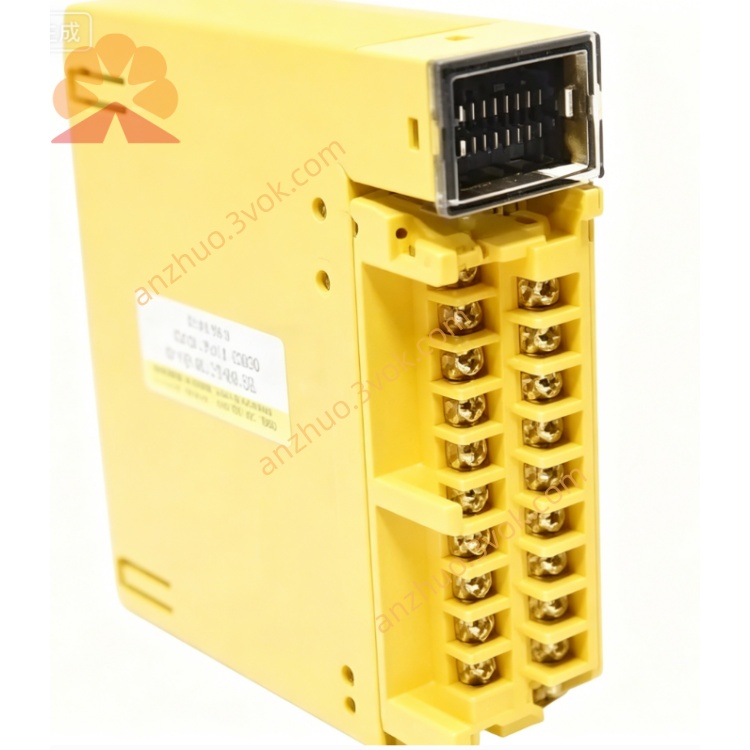
A06B-0267-B605#S000
Description
Main Technical Specifications
Model: A06B-0267-B605#S000 (AM30/3000i)
Rated Continuous Output Power: 4.3 kW
Rated Continuous Torque: 30 Nm (stall torque)
Rated Speed: 2000 rpm; Maximum Speed: 3000 rpm
Rated Voltage: Three-phase 179 V AC (200–240 V system)
Rated Current: 14 A; Peak Current: 42 A
Frequency: 133 Hz
Encoder: Built-in a64ia incremental encoder
Shaft: Tapered shaft (TPR) with keyway
Brake: 90 V DC electromagnetic power-off holding brake
Protection Class: IP65 (dust-tight, splash-proof)
Insulation Class: F (155 °C)
Cooling: Natural convection (self-cooled)
Approximate Weight: 17–19 kg (gross weight 30.6 kg)
Dimensions: 48 × 21.5 × 29 cm
Power Supply: 200–230 V ~, 3-phase, 50/60 Hz
Product Features
High Torque Density: 30 Nm continuous torque in a compact frame, optimized for heavy feed axes and vertical loads.
90V Holding Brake: Integrated 90V DC brake provides reliable static holding for suspended/vertical loads, enhancing safety.
Tapered Shaft Design: Tapered shaft (TPR) with keyway ensures secure load connection and precise torque transmission.
Precision Incremental Encoder: Built-in a64ia encoder delivers high-resolution feedback for accurate positioning and smooth motion.
Rugged IP65 Construction: Withstands coolant, oil mist, and dust in harsh workshop environments.
Low Rotor Inertia: Enables fast acceleration/deceleration for high-speed contouring and dynamic motion control.
Wide System Compatibility: Matches FANUC 0i-D, 30i-B series CNC and αi-B series 200V servo amplifiers.
High Durability: Sealed bearings and F-class insulation ensure long-term stable operation in industrial conditions.
Application Scope
CNC Machine Tools: Heavy-duty milling machines, vertical lathes, and high-load feed axes.
Vertical Axis Applications: CNC vertical machines, gantry systems, and suspended load mechanisms (brake critical for safety).
Industrial Automation: Gantry robots, linear motion platforms, and packaging machinery requiring high torque.
Special Machines: Material handling equipment, process machinery, and automation cells with 200V power systems.
Installation Instructions
Mount the motor on a rigid, flat base to avoid resonance and misalignment.
Keep the mounting surface clean, flat, and free of debris or deformation.
Align the tapered shaft with the load; use a flexible coupling to compensate for minor misalignment.
Tighten flange bolts evenly to the specified torque to prevent housing distortion.
Reserve sufficient clearance around the motor for natural heat dissipation and maintenance access; do not block cooling fins.
After installation, verify the brake’s release and holding functions operate correctly.
Wiring Requirements
Perform all wiring with the power disconnected; 200V poses an electric shock risk.
Use FANUC-approved power, encoder, brake, and ground cables.
Connect the three-phase power lines (U, V, W) and protective earth (PE) securely.
Route encoder signal cables and brake control cables separately from main power cables to avoid electromagnetic interference (EMI).
Ensure all wiring terminals are tightly fastened with good insulation performance (≥100 MΩ at 500 VDC).
Follow FANUC’s official standard wiring specifications for servo motor and brake circuit connections.
Working Environment
Operating Temperature: 0 °C to +40 °C
Storage Temperature: −20 °C to +60 °C (non-condensing)
Humidity: 5%–95% RH (non-condensing)
Altitude: ≤1000 m (derate output above 1000 m)
Atmosphere: Free of corrosive gases, explosive dust, or excessive oil mist
Vibration: ≤5G (avoid long-term strong mechanical vibration and impact)
Operation Guidelines
Operate the motor strictly within rated voltage, torque, and speed limits; do not overload continuously.
Perform a no-load trial run after installation to check for abnormal noise, vibration, or excessive temperature rise.
Monitor the motor housing temperature during operation; ensure surface temperature ≤100 °C.
Avoid excessive start-stop cycles to prevent overheating and mechanical wear.
Set servo amplifier parameters correctly based on the motor model and actual load conditions.
For the brake-equipped motor, use the brake only for static holding, not for dynamic emergency stops.
Maintenance Instructions
Regularly cut off the power and clean dust, oil stains, and coolant from the motor housing.
Periodically check the mounting bolts, coupling tightness, encoder connectors, and brake wiring for security.
Listen for abnormal bearing noise and inspect for excessive vibration during operation.
Regularly use the CNC system’s diagnostic function to check encoder signal quality and positioning stability.
Do not disassemble the motor or encoder privately; this will damage precision components and void the warranty.
Periodically test the brake’s holding performance; replace wearing parts if holding torque decreases.
Safety Precautions
Only qualified personnel trained in 200V systems may install, wire, or maintain the motor.
Disconnect all power before maintenance or wiring work; wait for capacitors to fully discharge.
Never touch the rotating shaft or live electrical components during motor operation.
Ensure reliable grounding to prevent electric shock and reduce EMI.
Do not modify the motor’s internal structure or circuit configuration arbitrarily.
Keep the motor and cables away from flammable materials and high-temperature heat sources.
Get a Quote