
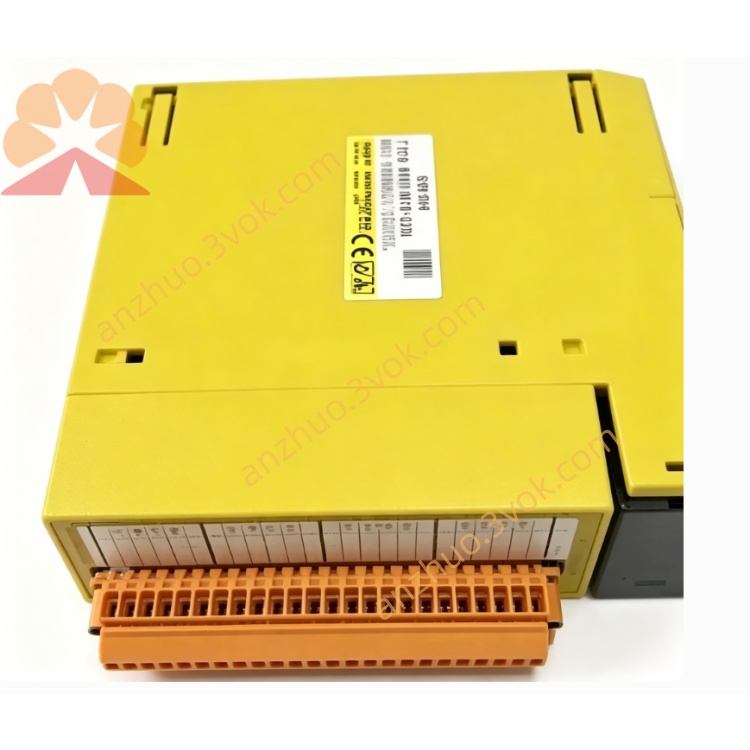
A06B-0249-B500
Description
2. Technical Specifications
Electrical Data
Rated Output Power: 4.0 kW
Rated Torque: 22 Nm (continuous)
Peak Torque: 66 Nm (short‑term)
Rated Speed: 3000 min⁻¹
Maximum Speed: 3500 min⁻¹
Rated Voltage: 3‑phase 400 V AC (HV series)
Rated Current: 11 A
Peak Current: 40 A
Back‑EMF Constant: 84 V
Winding Resistance: 0.66 Ω
Insulation Class: F (155 °C)
Protection Class: IP65 (IEC 60529)
Cooling Method: Natural convection (self‑cooled)
Brake Voltage: 24 V DC
Brake Holding Torque: 22 Nm (static)
Mechanical Data
Shaft: Straight ø24 mm with keyway
Mounting Flange: Standard IEC/ISO flange
Approximate Weight: 19 kg
Vibration Grade: Vibration class A
Noise Level: ≤70 dB(A) at 1 m (no load)
3. Construction and Components
Stator: High‑efficiency laminated core with vacuum‑impregnated windings, ensuring high dielectric strength and reliability for high‑voltage operation.
Rotor: Rare‑earth permanent magnet design, delivering high torque density and low inertia for fast dynamic response in high‑speed applications.
Shaft and Bearings: Precision‑ground alloy steel shaft paired with heavy‑duty deep‑groove ball bearings, providing long service life and minimal runout under high‑load conditions.
Electromagnetic Brake: Integrated 24 V DC spring‑applied, electrically released brake, providing reliable static holding torque to prevent load movement during power‑off or emergency stop.
Encoder System: Integrated a1000 incremental encoder offering high‑resolution position and speed feedback (1,000,000 counts/rev) for precise motion control.
Housing: Robust aluminum alloy housing with optimized heat dissipation, fully sealed to IP65 to resist dust, coolant, and oil mist in harsh workshop environments.
4. Features and Benefits
High‑Voltage (400 V) Design: Optimized for 400 V AC industrial power supplies, reducing current load and enabling longer cable runs with lower power loss.
Integrated Holding Brake: 24 V DC brake provides 22 Nm static holding torque, ensuring load security in vertical or suspended axes during power‑off.
Sealed IP65 Construction: Reliable performance in harsh environments with coolant splash, dust, and oil mist; IP67 protection available as an option.
High Torque Density: Compact dimensions with 22 Nm continuous torque, saving installation space in high‑power applications.
Fast Dynamic Response: Low rotor inertia enables rapid acceleration/deceleration, ideal for high‑speed contouring and positioning in CNC machining centers.
Smooth Operation: Optimized magnetic circuit design minimizes torque ripple, vibration, and noise during high‑speed operation.
High‑Reliability Feedback: Built‑in a1000 encoder ensures accurate position and speed control for high‑precision applications.
Wide Compatibility: Fully compatible with FANUC 0i, 30i/31i/32i series CNC systems and αi‑B series HV servo amplifiers.
5. Application Scope
CNC Machine Tools: High‑voltage machining centers, vertical lathes, and heavy‑duty machine tool feed axes, especially vertical axes requiring holding brake.
Precision Positioning: Gantry systems, linear motion platforms, and automation equipment requiring high accuracy, high power, and load holding capability.
Industrial Robots: Heavy‑payload robot joints and auxiliary axes in high‑voltage automation cells, particularly for vertical or inverted configurations.
General Automation: Packaging machinery, material handling systems, and special‑purpose machines with 400 V AC power supply and brake requirements.
Harsh Environment Applications: Machine tools with heavy coolant usage and dusty production lines requiring sealed motor construction and brake‑assisted load control.
6. Installation Instructions
Mechanical Installation
Mount the motor on a rigid, flat, vibration‑free base to prevent resonance and misalignment in high‑load operation.
Ensure the mounting surface is clean, flat, and free of debris to maintain flange integrity.
Align the motor shaft with the driven load (e.g., ballscrew, gearbox) within specified tolerance; use a flexible coupling to compensate for minor misalignment.
Tighten mounting bolts evenly to the recommended torque value to avoid flange distortion under high torque.
Maintain sufficient clearance around the motor for airflow, heat dissipation, and maintenance access; avoid blocking cooling fins.
Verify brake operation after installation: apply 24 V DC to release brake, remove power to engage brake, and confirm load holding.
Electrical Wiring
Disconnect and lock out all power sources before wiring; high‑voltage (400 V) systems pose electric shock risk.
Use only FANUC‑approved high‑voltage power cables, encoder cables, brake cables, and ground cables rated for 400 V AC and 24 V DC.
Connect the three‑phase power lines (U, V, W) and protective earth (PE) securely; ensure proper grounding for high‑voltage safety.
Connect brake wires to 24 V DC power supply; observe polarity for correct release/engagement.
Route encoder and brake cables separately from power cables to avoid electromagnetic interference; maintain minimum separation distance as specified in the amplifier manual.
Verify all connections are tight and insulated; use insulation resistance meter (500 V DC) to check winding‑to‑frame insulation (≥100 MΩ acceptable).
Follow the wiring diagram provided in the FANUC servo amplifier and motor manual for HV series systems with brake.
7. Operating Environment
Ambient Temperature: 0 °C to +40 °C (operation); −20 °C to +60 °C (storage, non‑condensing)
Humidity: 5 % to 95 % RH (non‑condensing)
Altitude: ≤1000 m above sea level (derate output above 1000 m)
Atmosphere: Free from corrosive gases, explosive dust, and excessive oil mist
Vibration: ≤0.5 g (continuous); ≤1 g (intermittent)
8. Operation Guidelines
Operate the motor within rated voltage (400 V), current, torque, and speed limits; avoid continuous overload in high‑voltage operation.
Brake Operation: Brake is spring‑applied (engaged) when 24 V DC is removed, and electrically released when 24 V DC is applied; never use brake for dynamic stopping during normal operation.
Perform a no‑load test run after installation to check for abnormal noise, vibration, or temperature rise; verify brake release/engagement cycle.
Monitor motor housing temperature during operation; surface temperature must not exceed 100 °C.
Avoid excessive frequent start‑stop cycles to prevent overheating and mechanical wear in high‑torque applications.
Ensure servo amplifier parameters are correctly set to match the motor model (A06B‑0249‑B500), 400 V HV series requirements, and brake control logic.
9. Maintenance and Inspection
Regular Inspection (Monthly/Quarterly)
Clean motor housing to remove dust, oil, or coolant buildup (power off first, high‑voltage safety).
Check mounting bolts and coupling tightness to prevent loosening under high torque.
Inspect encoder and brake cable connectors for damage, looseness, or corrosion; ensure shielding integrity.
Listen for abnormal bearing noise and check for excessive vibration during operation.
Confirm normal operating temperature and absence of unusual odor.
Test brake holding torque periodically to ensure load security.
Periodic Maintenance (Every 6–12 Months)
Inspect bearing grease condition; re‑grease or replace bearings if noise or roughness occurs (use FANUC‑specified grease).
Check shaft key and keyway for wear or deformation under high‑load conditions.
Verify encoder signal quality via CNC diagnostic functions; check for position drift.
Clean cooling fins and ventilation paths if necessary to maintain heat dissipation.
Perform a full load test to confirm torque and speed accuracy under 400 V operation.
Inspect brake friction surfaces for wear; replace brake assembly if holding torque degrades.
Lubrication
Bearings: Sealed, lifetime‑lubricated type under normal use; re‑lubricate only in heavy‑dust or high‑humidity environments with FANUC‑specified grease.
Brake: No lubrication required; keep friction surfaces clean and dry.
10. Troubleshooting (Common Issues)
Motor fails to start: Check 400 V power supply, wiring connections, servo amplifier enable signal, brake release voltage, and CNC alarm codes (e.g., overvoltage, undervoltage).
Abnormal noise/vibration: Inspect bearing condition, shaft alignment, coupling tightness, mounting rigidity, and brake friction surface contamination.
Excessive temperature rise: Check for overload, blocked ventilation, incorrect parameter settings, phase imbalance in 400 V supply, or brake dragging (not fully releasing).
Positioning error or drift: Verify encoder connection, cable shielding, grounding, encoder resolution settings, and brake holding accuracy.
Servo alarm (overcurrent/overvoltage): Check load condition, wiring, 400 V power supply stability, amplifier‑motor compatibility, and brake electrical circuit.
Brake not holding: Check 24 V DC power supply (no voltage = brake engaged), brake coil resistance, friction surface wear, or mechanical obstruction.
11. Safety Precautions
Only qualified personnel trained in high‑voltage (400 V) systems and brake‑equipped servo motors shall install, wire, maintain, or repair the motor.
Disconnect and lock out all power sources (400 V AC and 24 V DC) before performing any work on the motor, wiring, or brake; wait 5 minutes for capacitors to discharge.
Never touch rotating parts or live electrical components during operation; high‑voltage systems pose fatal electric shock risk.
Ensure proper grounding to prevent electric shock and reduce electromagnetic noise in high‑voltage operation.
Do not modify or disassemble the motor, encoder, or brake; this voids the warranty and may cause malfunction or injury.
Keep the motor and cables away from flammable materials and heat sources.
Never use the holding brake for dynamic stopping during normal operation; use servo amplifier braking for controlled deceleration.
12. Reference Information
Compatible Amplifiers: FANUC αi‑B series HV servo amplifiers (400 V) with brake control function
Compatible CNC Systems: FANUC 0i‑D, 0i‑MF, 30i/31i‑B series
Related Manuals: FANUC AC Servo Motor Manual (B‑65262EN), FANUC Servo Amplifier Manual (B‑65291EN), FANUC Brake‑Equipped Servo Motor Installation Guide
Series Specification: HV (High‑Voltage) 400 V AC, α22/3000HVi, straight keyed shaft, integrated 24 V DC brake, a1000 encoder, IP65
Get a Quote