
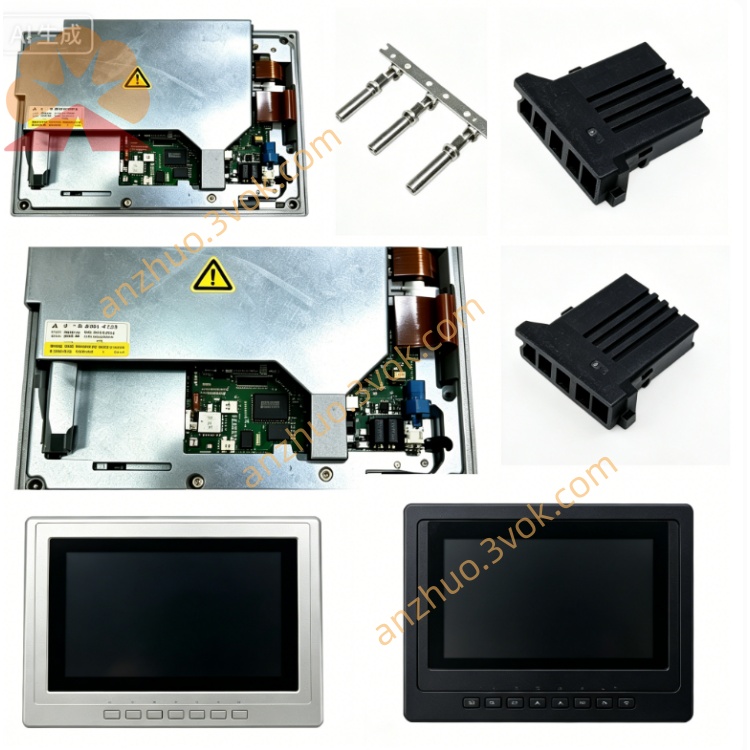
A06B-0075-B003
Description
2. Electrical Ratings
Rated Input Voltage: 200–240 VAC, 3-phase, 50/60 Hz
Rated Output Power: 1.2 kW
Rated Torque: 7.0 N·m
Rated Speed: 3000 rpm
Maximum Speed: 3000 rpm
Rated Current: 4.9 A
Insulation Class: Class F
Winding Configuration: Standard three-phase star connection
3. Mechanical Specifications
Mounting Type: Flange mounting
Cooling Method: Natural air cooling
Bearing Structure: Sealed lifelong lubricated bearing
Shaft Form: Standard taper shaft
Operating Noise Level: ≤ 68 dB(A)
Mechanical Structure: Fully enclosed fan-free design
4. Environmental Operating Conditions
Operating Ambient Temperature: 0°C to +40°C
Storage Temperature: -20°C to +60°C
Relative Humidity: 40% ~ 80% RH, non-condensing
Installation Altitude: Below 1000 meters above sea level
Vibration Resistance: 0.5g within 10Hz–100Hz frequency range
Corrosion Environment: Not suitable for direct use in strong corrosive, explosive and flammable atmosphere without protective measures
5. Main Features
Low inertia rotor design, fast dynamic response and excellent acceleration performance.
Equipped with high-resolution 128k incremental encoder, realizing high-precision position and speed closed-loop control.
IP65 protection grade, dust-proof and splash-proof, adaptable to ordinary industrial workshop environment.
Taper shaft design ensures high concentricity during coupling installation, reducing vibration and transmission backlash.
Brushless motor structure, low operation noise, no carbon brush wear, long service life.
Natural air cooling without external cooling fan, simple structure and high reliability.
Compact overall layout, high power density, easy mechanical installation and matching.
6. Application Scope
CNC lathe, milling machine and machining center feed axis
Industrial automation production line positioning mechanism
High-speed precision servo positioning system
Industrial robot joint drive unit
Packaging machinery, printing machinery and automated transmission equipment
General industrial motion control occasions without vertical drop load
7. Installation Guidelines
Install the motor on a rigid, flat and deformation-free mounting base to avoid resonance and mechanical stress.
Keep high precision alignment between motor taper shaft and coupling to prevent vibration, noise and premature bearing damage.
Use dedicated shielded servo power cable and encoder cable, separate power wiring and signal wiring to reduce electromagnetic interference.
Reserve enough surrounding space for natural heat dissipation; do not cover or block the motor shell heat dissipation area.
Avoid strong impact, drop and extrusion on the motor body and encoder rear cover during handling and installation.
8. Maintenance Instructions
Regularly inspect running status including abnormal noise, vibration and temperature rise.
Keep motor surface clean, remove dust, metal chips and oil contamination periodically.
Built-in bearings adopt sealed lifelong lubrication, no regular refueling maintenance required under normal working conditions.
Check encoder cable integrity, connector fastening and aging status at regular intervals.
Avoid long-term overload operation and frequent forward and reverse start-stop beyond allowable range.
9. Safety Precautions
Cut off all power supply before installation, wiring, disassembly and maintenance. Wait at least 15 minutes for internal capacitor discharge to prevent electric shock hazard.
Do not touch the rotating shaft and moving parts during motor running state.
This model has no holding brake; do not apply to vertical axis or suspended load which has falling risk without external mechanical locking device.
Do not disassemble the motor and encoder privately; unauthorized disassembly will void the warranty and cause precision damage.
Do not use in environment with conductive dust, strong moisture condensation and chemical corrosion without special protection.
10. Troubleshooting
Motor cannot start: Check three-phase power supply, wiring tightness, servo amplifier alarm code and enable signal.
Abnormal noise and vibration: Check mounting rigidity, coupling alignment, bearing aging and mechanical load jamming.
Motor overheating: Inspect long-term overload, ambient temperature over limit, poor ventilation and winding insulation deterioration.
Positioning deviation and out of tolerance: Check encoder cable breakage, loose connector, servo parameter mismatch and mechanical transmission backlash.
Unstable speed: Verify power supply voltage fluctuation, load mutation and encoder signal interference.
Get a Quote