
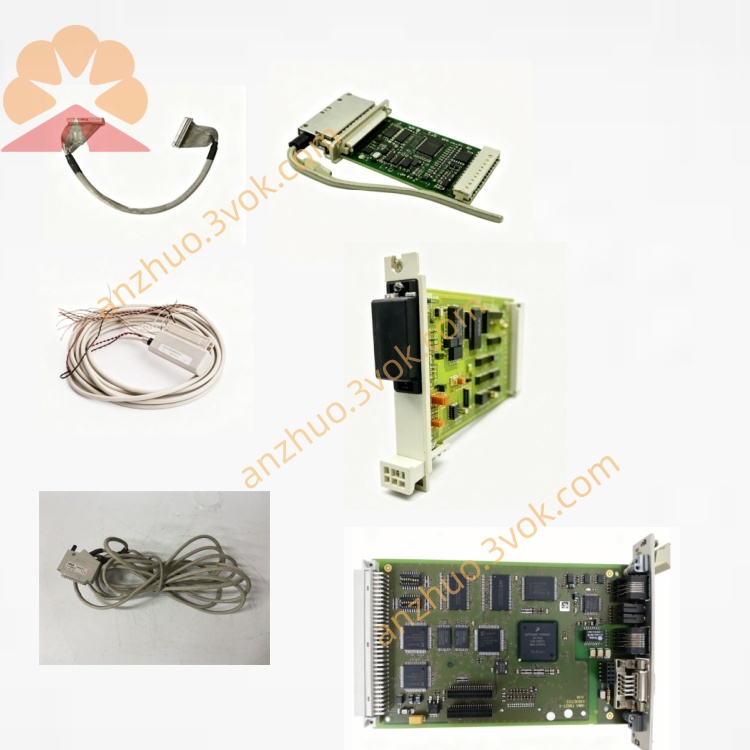
H4136
Description
I. Basic Information and Certification
Model: H4136 (0530)
Brand: HIMA (Germany)
Type: Safety Relay Amplifier (Relay Amplifier)
Safety Level: SIL3 (IEC 61508), AK 5/6, PL e/Cat.4
Certification: CE, UL, TÜV, EN 298, DIN VDE 0116, NFPA 8501/8502
Installation: 19-inch standard rack slot (compatible with H41q/F series)
Protection: IP20; Operating Temperature: -25°C ~ +60°C; Storage Temperature: -40°C ~ +85°C
II. Core Technical Parameters
Input: 24VDC (±15%), control signal input; current consumption ≈ 20mA
Output: 3 redundant relay contacts (K1/K2/K3), no potential conversion contacts
Contact capacity: ≤ 250VAC/VDC, ≤ 4A (safety application ≤ 60% of rated value)
Switch capacity: AC ≤ 1000VA (cosφ > 0.5); DC ≤ 120W (30V)
Fuse: Built-in F1 (max 4A slow-blow, factory default 2.5A-T), terminal 8 can monitor fuse status
Timing: Suction ≈ 7ms; Release ≈ 5ms; Insulation strength ≥ 500VAC (input/output isolation)
III. Terminal Definitions and Wiring Table
Terminal Function Explanation
1 +24VDC Positive terminal of power supply
2 0V Negative terminal of power supply
3 Input+ Control signal input +
4 Input- Control signal input -
5 K1 common terminal Common contact of relay 1
6 K1 NO Normally open contact of relay 1
7 K1 NC Normally closed contact of relay 1
8 F1 monitoring Insulation F1 status monitoring
9~14 K2/K3 contacts Same as K1 (redundant circuit)
Connection points:
Power supply: 24VDC redundant power supply, reverse connection / overvoltage protection;
Input: Passive dry contact or 24VDC level control signal;
Output: Independent power supply for load, series connection to enhance safety;
Insulation fuse: F1 = 2.5A slow melting, do not replace with non-standard parts;
Shielding: Single-ended grounding of analog / signal cable shielding layer.
Four. Working principle and safety characteristics
Redundant safety architecture: Three relays (K1/K2/K3) adopt diversity design, synchronous operation, single-line failure does not affect safety output, meets SIL3 fault-tolerant requirements.
Safety isolation: Electrical isolation between input/output (DIN EN 50178), prevents fault cross-loop diffusion.
Insulation fuse monitoring: Terminal 8 monitors the status of F1 in real time, triggers system alarm when fuse melts.
Fault safety: When power is lost / fault, relays are forced to open, output in safe state (complies with ESD/BMS "power loss safety" principle).
Five. Installation and debugging steps
Installation:
Frame: 19-inch standard slot, vertical installation, spacing ≥ 20mm (heat dissipation);
Environment: No strong electromagnetic interference, no corrosion / dust, temperature - 25℃~+60℃.
Connection:
Power off operation, cable diameter ≤ 2.5mm² (AWG14);
Power supply, input, output separate wiring, away from power cables.
Power-on test:
No-load power-on: Power LED is on, no alarm;
Input test: Input 24VDC control signal, relay engages (NO → closed, NC → open);
Redundancy verification: Simulate single-line relay failure, other two circuits operate normally;
Insulation fuse test: Short-circuit terminal 8 to 0V, trigger alarm (optional).
Configuration: Configure logic through HIMA ProSafe/ELOP II software, associate SIS system interlock conditions.
Six. Maintenance and fault troubleshooting
Daily maintenance:
Period: Check wiring tightness, no burn marks on contacts, insulation fuse is intact every 6 months;
Cleaning: Blow dust with dry compressed air after power off, do not use liquid cleaning.
Common faults:
Relay does not engage: Power abnormal / input signal invalid / coil damaged → check 24VDC, input circuit, replace module;
Contact sticking: Overload / frequent operation → reduce load to 60% rated value, replace module;
Insulation fuse melting: Output short circuit / overload → investigate load circuit, replace 2.5A slow-melting insulation fuse;
Alarm abnormality: Terminal 8 wiring error / insulation fuse damaged → review wiring, replace insulation fuse.
Seven. Safety precautions
Only for safety-related circuits (SIL3), do not use in non-safety scenarios;
Installation / maintenance must be operated by certified professionals, follow ESD protection (anti-static wristband);
Faulty modules are prohibited from on-site repair, return to HIMA original factory or authorized service provider for handling;
Strictly follow the power loss safety principle: System failure / power loss, output must be in a safe state;
Regular verification: Conduct SIS system test annually to verify relay action logic and safety integrity.
Get a Quote